
All day long, you've managed to stay busy.
You've gone to work.
Run errands.
Prepared for your baby.
Talked to friends.
But then...
The house becomes quiet.
You climb into bed.
The lights go out.
And suddenly your mind won't stop.
"What if something is wrong?"
"What if I don't notice a problem?"
"Will I be okay during labor?"
"Why can't I stop worrying?"
If pregnancy anxiety seems to get worse every night, you're not imagining it.
Many expecting mothers notice that their worries become more intense after dark. Understanding why this happens can help you feel less alone and give you practical ways to calm your mind before sleep.
Your brain isn't necessarily becoming more anxious.
Instead, your environment changes.
During the day, you're distracted by work, conversations, appointments, and daily responsibilities.
At night, those distractions disappear.
Without anything competing for your attention, anxious thoughts can feel much louder.
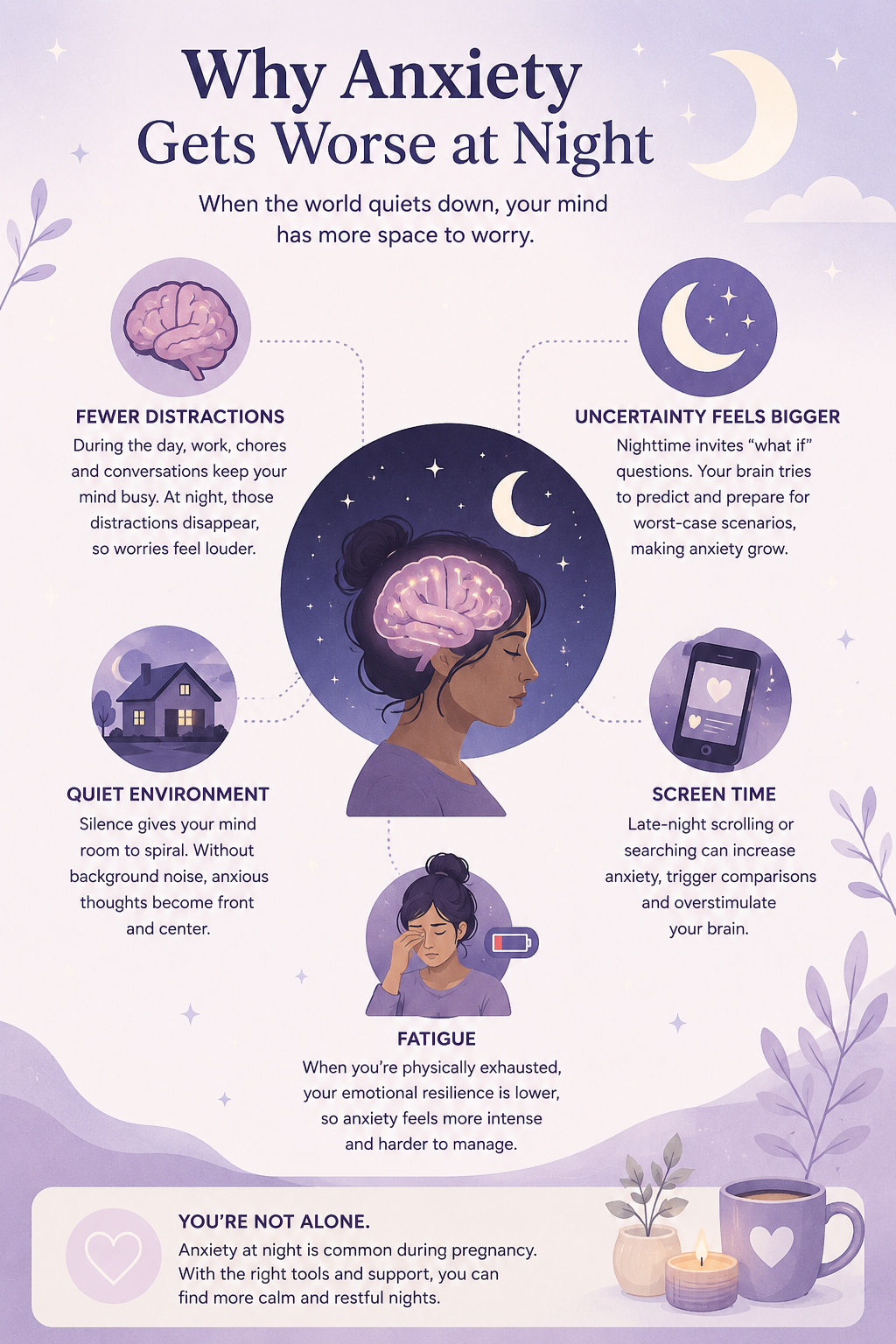
For many people, nighttime becomes planning time.
Your brain starts asking questions like:
It's common for the mind to start trying to solve uncertainty before sleep, even when there aren't clear answers.
Several changes during pregnancy can make nighttime anxiety feel more intense:
Hormonal changes during pregnancy may affect mood and emotions for some people.
Difficulty finding a comfortable sleeping position can make it harder to relax.
When you're exhausted, anxious thoughts may feel harder to manage.
Without daytime distractions, your mind naturally fills the silence.
Pregnancy often brings new physical sensations that become much more noticeable once you're lying quietly in bed. Even normal pregnancy changes can feel unsettling when your mind has fewer distractions.
You may notice your baby's movements more, become aware of Braxton Hicks contractions, experience heartburn, pelvic discomfort, or wake up frequently to use the bathroom. Some expecting moms also find themselves paying closer attention to changes in breathing or vivid dreams.
When anxiety is already present, it's easy to assume these sensations mean something is wrong. Many physical symptoms during pregnancy can have normal explanations. If you'd like to learn more about how anxiety can affect the body, read our guide to physical symptoms of pregnancy anxiety.
At the same time, it's important not to ignore symptoms that are new, severe, persistent, or concerning. If you're ever unsure, contact your healthcare provider for guidance.
Understanding that pregnancy symptoms and anxiety can sometimes reinforce each other may help you respond with curiosity instead of immediately assuming the worst.
Many moms experience thoughts like:
If these worries happen frequently, you may also find our guide to pregnancy anxiety helpful.
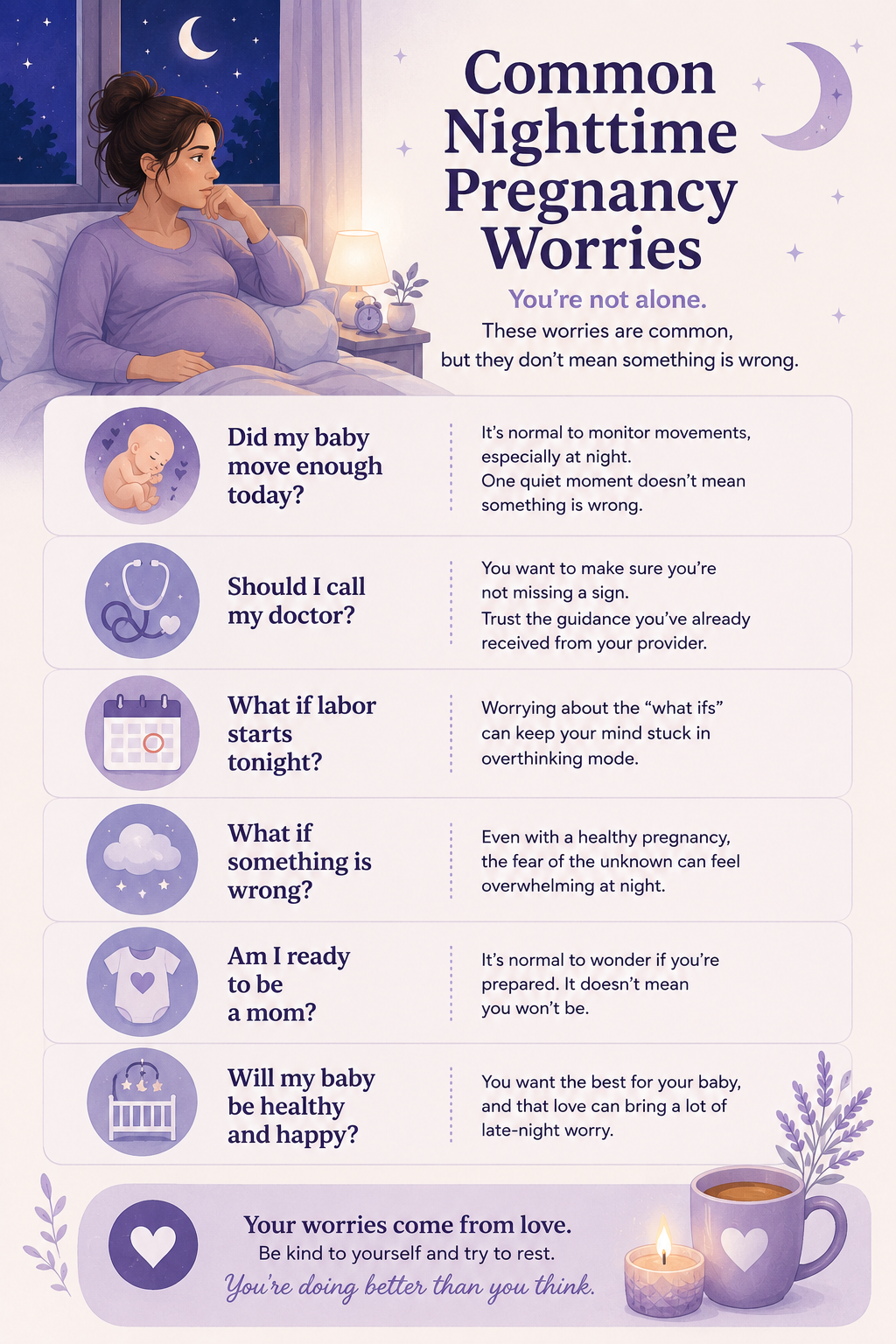
There's another reason nighttime anxiety can feel so overwhelming: by bedtime, your mind has often spent an entire day making decisions, solving problems, and processing emotions.
When you're tired, it can be harder to put worries into perspective. Thoughts that might have felt manageable during the afternoon can suddenly seem much more urgent once you're lying in bed.
Many expecting moms notice this pattern:
The thought may not have changed, but when you're tired, it can feel much harder to see it objectively.
That doesn't mean your fears are true. It simply means your mind has fewer mental resources available after a long day.
If pregnancy anxiety feels worse at night, it doesn't mean you're doing anything wrong.
Many expecting moms naturally become more aware of every kick, every cramp, every new sensation, and every change in their body. During pregnancy, it's common to pay closer attention because so much is changing.
Sometimes that protective instinct can make uncertainty feel more threatening than it really is.
A perfectly normal sensation becomes something to analyze.
A quiet moment becomes something to question.
A harmless "what if?" turns into a long chain of anxious thoughts.
Recognizing that your mind is trying to protect—not harm—you can make these thoughts feel less overwhelming. Instead of seeing every anxious thought as a warning sign, try to see it for what it often is: a reflection of how deeply you already care about your baby.
One of the most frustrating parts of pregnancy anxiety is that the same worries often replay night after night.
You reassure yourself.
You finally fall asleep.
Then the next evening, the thoughts return.
This can leave you wondering why you can't simply "let it go." The truth is, anxiety doesn't work that way.
Instead of looking for an answer, anxiety often looks for certainty. During pregnancy, many of the questions your mind asks simply don't have guarantees.
You may find yourself thinking:
Because no one can predict the future, your mind may keep revisiting these questions, hoping that thinking about them one more time will finally make you feel certain.
The problem is that certainty isn't something anxiety can usually find. The more you chase it, the more your mind may come up with another "what if?" to solve.
Recognizing this pattern can help you step out of the cycle instead of feeling like you have to answer every anxious thought before you can fall asleep.
Many expecting moms notice something surprising.
The thoughts that felt overwhelming at 11:00 p.m. often don't seem nearly as frightening the next morning.
This doesn't mean your worries weren't real to you—it simply shows how much your environment and energy level can influence anxious thoughts.
Morning often brings daylight, activity, conversations, and new things to focus on. As your attention naturally shifts back to your daily routine, the same thought that felt impossible to ignore during a quiet night may lose some of its intensity.
If you've ever woken up wondering, "Why was I so worried last night?" you're far from alone. Many moms experience this pattern throughout pregnancy.
Many moms notice the same pattern happening night after night.
A worry appears.
You try to solve it.
Another "what if?" pops into your mind.
Before long, an hour has passed and you're still awake.
Rather than trying to eliminate every anxious thought, it can help to simply notice what's happening. Anxiety often asks questions that don't have immediate answers, especially during pregnancy. If your mind tends to replay the same thoughts throughout the day as well as at night, our article on racing thoughts during pregnancy may also help.
Instead of answering every anxious thought, gently acknowledge it and bring your attention back to the present moment. With practice, this can make it easier to step out of the cycle instead of getting pulled deeper into it.
If you're awake wondering whether you're worrying too much, chances are many other expecting moms are awake asking themselves the very same question.
Pregnancy brings incredible change—physically, emotionally, and mentally. It's natural to think more about your baby's well-being, your upcoming birth, and how life is about to change.
Having anxious thoughts doesn't mean something is wrong with you, and it doesn't mean something is wrong with your pregnancy. These thoughts can be a normal response to the uncertainty that comes with preparing for one of life's biggest transitions.
The goal isn't to eliminate every worry. It's to notice anxious thoughts without letting them take over your entire evening.
With time, healthy bedtime habits, and the right support, many expecting moms find that bedtime becomes less overwhelming and more restful.
When you're feeling anxious, it's natural to want reassurance. Unfortunately, some habits can unintentionally make anxiety feel even stronger.
Try to avoid:
Instead, remind yourself that anxious thoughts aren't always accurate predictions. If you have a genuine medical concern or new symptoms, contact your healthcare provider. Otherwise, give yourself permission to practice one calming technique before looking for more reassurance.
If nighttime anxiety has become part of your evening routine, small changes before bed can make a meaningful difference. The goal isn't to force anxious thoughts away—it's to help your mind and body feel safe enough to rest.
Spend 20 to 30 minutes helping your body transition into sleep.
Instead of going straight from work, chores, or scrolling on your phone into bed, create a calming routine that signals to your brain that the day is coming to an end. This might include dimming the lights, taking a warm shower, stretching gently, reading a book, or listening to relaxing music.
Repeating the same calming routine each night can make it easier for your mind to settle over time.
It's tempting to search every new symptom or read one more pregnancy article before bed.
Unfortunately, late-night Googling often increases anxiety rather than relieving it. Reading alarming stories or searching for reassurance can leave your mind with even more unanswered questions.
If you have a new, severe, persistent, or concerning symptom, contact your healthcare provider. Otherwise, consider giving yourself permission to leave the internet until morning.
When anxiety rises, your breathing often becomes quicker and shallower.
Slowing your breath may help your body feel more relaxed.
Try inhaling slowly through your nose for a count of four, then exhaling gently through your mouth for a count of six. Repeat this for a few minutes while allowing your shoulders and jaw to soften.
You don't have to stop every anxious thought. Simply giving your body a chance to relax can help reduce their intensity.
Many expecting moms find that guided relaxation, mindfulness, or calming audio helps interrupt racing thoughts before sleep.
Instead of trying to force your mind to become quiet, guided sessions can gently redirect your attention.
Even just 10 to 15 minutes of guided relaxation can help you end the day feeling calmer and more grounded.
MamaZen includes guided sessions for pregnancy anxiety, relaxation, mindfulness, and better sleep designed specifically for expecting moms.
Anxiety likes to focus on everything that could happen tomorrow.
Instead, gently bring your attention back to today.
Ask yourself:
You don't need to solve every uncertainty before you fall asleep. Sometimes reminding yourself what is true right now is enough to help your mind begin to rest.
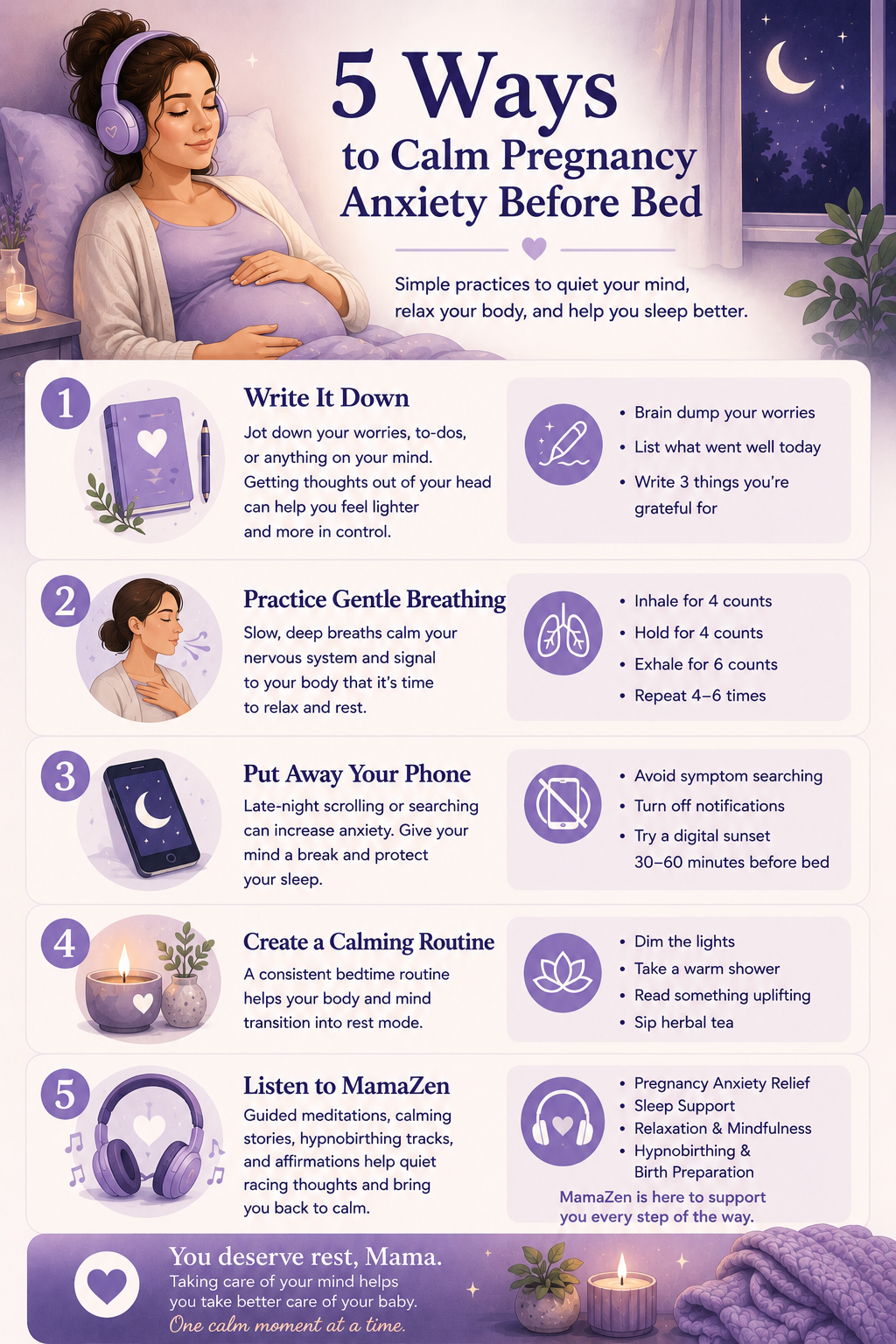
If anxiety tends to appear around the same time every evening, creating a predictable bedtime routine can help your body transition into rest.
Consider trying this simple routine:
You don't need a perfect bedtime routine for it to help. Small, consistent habits repeated over time can make evenings feel calmer and more predictable.
If nighttime anxiety is keeping you awake most nights, causing panic attacks, or making it difficult to function during the day, speak with your healthcare provider. Pregnancy anxiety is common, and support is available.
While occasional worry can be a normal part of pregnancy, persistent or overwhelming anxiety deserves attention. If your worries are becoming difficult to manage, interfering with your sleep or daily life, or you're concerned about how you're feeling, don't hesitate to reach out to your healthcare provider. They can help determine what's causing your symptoms and discuss appropriate support.
You may also find it helpful to learn more about pregnancy anxiety, including common symptoms and ways to find support.
Many expecting moms notice that anxious thoughts feel stronger after dark. With fewer distractions and more quiet time, worries often become more noticeable.
Hormonal changes may influence mood during pregnancy, but sleep changes, physical discomfort, stress, and uncertainty about becoming a parent can also contribute to nighttime anxiety.
Yes. Anxiety and poor sleep often reinforce one another. Difficulty sleeping can make it harder to cope with stress the following day, while anxiety can make it more difficult to fall asleep or stay asleep.
Feeling anxious occasionally is common during pregnancy. If anxiety becomes persistent, overwhelming, or begins interfering with your daily life, talk with your healthcare provider so they can recommend appropriate support.

Just because your worries get louder at night doesn't mean they're more true.
Nighttime simply gives anxiety more room to speak.
With healthy bedtime habits, relaxation techniques, and the right support, your evenings can become a place of rest instead of worry.
MamaZen offers guided sessions for pregnancy anxiety, better sleep during pregnancy, hypnobirthing, and birth preparation to help you end your day feeling calmer and more connected.
Irin Rubin is the CEO and co-founder of MamaZen and the author of The MamaZen Method. Inspired by her own experience with pregnancy and postpartum anxiety, she has spent years developing mindfulness and cognitive hypnotherapy programs that support emotional well-being during pregnancy, birth, postpartum, and parenting.


Science-based Mindpower Sessions® help you create lasting change for you and your family.

Get instant relief right when you need it with our 5-7 Minute Emergency Sessions.

Empowering Kids to conquer anxiety, build confidence, and foster positive self-talk.

Supporting and guiding you through every step of parenthood.
Get expert tips to raise confident kids.
Enter email for access!