
If the thought of getting an epidural makes your stomach tighten, you're far from alone.
Fear of an epidural during labor is something many expecting mothers experience, even when they know they may want an epidural for pain relief.
You may actually feel relieved knowing pain relief will be available during labor. And yet, the idea of a needle going into your back can still feel terrifying.
Maybe you've found yourself thinking:
"What if it really hurts?"
"What if I move while they're doing it?"
"What if something goes wrong?"
"What if I can't handle the feeling of being numb?"
"What if the epidural doesn't work?"
Or maybe you weren't particularly worried until you heard someone else's birth story, watched a video online, or started reading about epidurals late at night.
Fear of an epidural can become a significant part of a larger fear of giving birth. Sometimes the anticipation of the procedure feels even more frightening than the procedure itself.
Understanding what you're actually afraid of, learning what generally happens during epidural placement, and preparing yourself mentally for the experience can help make the unknown feel more manageable.
Yes. There are many reasons someone may feel nervous about an epidural.
For some women, it's primarily a fear of needles. The idea of a needle being placed near the spine can sound especially intimidating.
For others, the fear is less about the needle and more about feeling vulnerable or out of control during labor.
You might worry about having to remain still during contractions. You may be uncomfortable with the idea of numbness. You might worry about possible side effects or complications. Or perhaps you're afraid you'll ask for an epidural and then panic when it's actually time to receive it.
Sometimes there isn't even one specific fear.
The entire experience simply feels unknown.
Pregnancy gives you a lot of time to imagine what labor might be like, and your mind may try to fill in the parts it doesn't know. Unfortunately, an anxious mind doesn't always fill those gaps with the most reassuring possibilities.
It often jumps straight to:
"What if...?"
And once that cycle starts, researching the procedure repeatedly doesn't always make the anxiety disappear.
An epidural combines several things that can naturally trigger anxiety: uncertainty, a medical procedure, unfamiliar physical sensations, and a moment when you may already feel physically and emotionally vulnerable.
Your brain also tends to pay more attention to things it interprets as potential threats.
So if you're already frightened of the epidural, you may find yourself noticing every negative story about one while barely registering the routine experiences you never hear about.
One frightening birth story can suddenly become the scenario your mind expects for you.
You might begin mentally rehearsing the moment:
You picture the room.
You picture the needle.
You imagine having a contraction at exactly the wrong time.
You imagine yourself moving.
Then your body begins responding to something that hasn't actually happened yet.
Your shoulders tense.
Your breathing changes.
Your heart may beat faster.
And those sensations can make the thought feel even more threatening.
This is one reason preparing for birth isn't only about knowing what will happen physically. Preparing your mind for moments you're worried about can be valuable too.
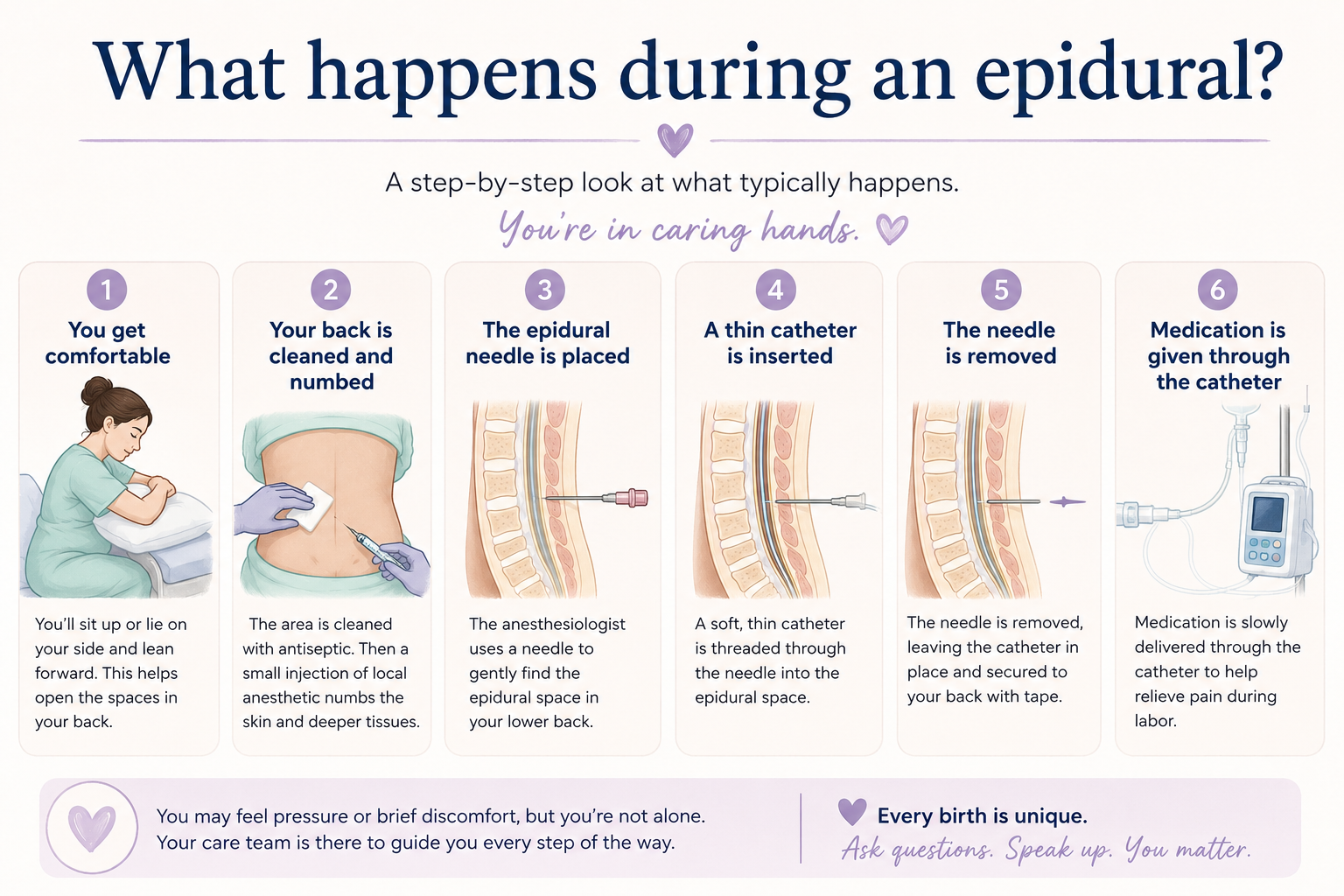
One of the simplest ways to reduce some of the uncertainty surrounding an epidural is to understand the general process.
Exact procedures can vary depending on the hospital, your medical circumstances, and your anesthesia team, but epidural placement generally involves several steps.
Before the procedure, your healthcare team will help position you so the anesthesia professional can access your lower back. You may be sitting up or lying on your side.
Your back is cleaned, and medication is typically used to numb the skin where the epidural will be placed.
An epidural needle is then used to access the epidural space in your back. A very thin catheter is threaded into place so medication can be delivered through it.
The needle itself is removed.
The catheter remains secured in place so pain-relieving medication can continue to be administered during labor.
Your healthcare team will then monitor you and assess how the epidural is working.
If you're anxious about the procedure, you can tell your healthcare team. You don't have to pretend you're completely comfortable with what's happening.
You can also ask your provider during pregnancy what the process typically looks like at the hospital where you plan to give birth. Knowing what to expect in your specific birth setting may make the experience feel less unfamiliar.
This is probably one of the first questions that comes to mind when you're afraid of an epidural.
There isn't one universal answer because everyone's experience of pain and physical sensation is different.
Local anesthetic is generally used to numb the area before the epidural is placed. During the process, people may experience sensations such as pressure, pushing, stinging, or discomfort.
Your experience may also be influenced by what's happening during labor at the same time.
Rather than trying to convince yourself that you won't feel anything, it can be more helpful to approach the experience with a flexible expectation:
There may be sensations I don't particularly like, but I can prepare for how I want to respond to them.
That's a very different mindset from spending weeks trying to guarantee that the procedure won't hurt at all.
If you have specific concerns about pain during epidural placement, talk with your OB, midwife, or anesthesia team about what you can realistically expect.
This is another common fear.
The thought usually goes something like this:
"I'm going to have a contraction. I'm going to move. Something terrible is going to happen."
But you aren't expected to manage the entire situation by yourself.
Your healthcare team will help position you and give you instructions throughout the procedure. They know you're in labor. They know contractions happen.
If you're particularly worried about staying still, tell them.
You can also begin practicing a simple mental strategy before labor: instead of thinking about the entire procedure, give your attention to one thing at a time.
Your breath.
A familiar voice.
A point in the room.
A phrase you've practiced.
Your partner's hand.
The instructions you're receiving.
The goal isn't necessarily to make yourself feel completely fearless.
It's to give your mind somewhere to go besides the frightening scenario it has been rehearsing.
Being afraid of needles doesn't mean you can't cope with an epidural.
It also doesn't mean you need to force yourself to look at the equipment or know every visual detail of the procedure.
If seeing medical equipment increases your anxiety, you can tell your healthcare team that you'd prefer not to see it.
You might also decide ahead of time how much information helps you.
Some people feel calmer when the provider explains each step as it happens.
Others become more anxious when they hear every detail and would rather receive only the instructions they need.
Neither approach is inherently better.
The question is:
What helps you feel most grounded?
You can communicate that preference before or during labor.
And this is something you can mentally prepare for before your due date.
If the epidural is already something you know you're nervous about, you don't have to wait until active labor to figure out how you're going to cope with that moment.
You can practice beforehand.
MamaZen includes an Active Labor: Epidural Mindpower Session created specifically to support you around the epidural experience.
You can listen during pregnancy to mentally familiarize yourself with the moment and practice directing your attention away from anxious thoughts and toward a calmer internal focus.
Then, if you choose an epidural during labor and circumstances allow, you can return to the session when you need that support most.
Instead of encountering the moment for the first time while you're already in labor, your mind has something familiar to return to.
A familiar voice.
A familiar focus.
A familiar way of calming yourself.
You don't need to promise yourself that you won't feel nervous.
You can prepare yourself to meet that nervousness differently.
Prepare for a calmer birth with MamaZen →
Another fear that can create a lot of anxiety is:
"What if I go through all of that and the epidural doesn't even work?"
It's understandable to want certainty, especially if you're considering an epidural because you're worried about labor pain.
Epidurals are intended to provide pain relief during labor, but the experience isn't identical for everyone. The degree of pain relief can vary, and sometimes an epidural may provide uneven or incomplete relief.
If you're still experiencing significant pain or one side of your body feels different from the other, tell your healthcare team.
Your anesthesia team can assess what's happening and determine whether adjustments are appropriate.
Knowing this beforehand can help shift the thought from:
"What if it doesn't work and I'm stuck?"
to:
"If something doesn't feel right, I can communicate with my healthcare team and they can evaluate what's happening."
Anxiety often makes us imagine a difficult situation in which we're completely powerless. In reality, you'll have a healthcare team who can respond to what's happening during your labor.
You don't have to silently tolerate something because you think it's supposed to feel a certain way.
Sometimes the fear isn't actually about having the epidural placed.
It's about what happens afterward.
You may be wondering:
"Will I still feel my legs?"
"Will I feel trapped in my body?"
"Will I still know when I'm having a contraction?"
"What if I hate feeling numb?"
If being unable to move normally or experiencing unfamiliar physical sensations makes you anxious, this part of an epidural may feel particularly important to understand before labor.
How an epidural feels can vary depending on factors such as the medications used, dosage, your individual response, and your labor circumstances. You may still experience pressure or other sensations even when pain is significantly reduced.
Rather than relying on someone else's description of exactly what an epidural will feel like, ask your healthcare provider what patients at your hospital can typically expect.
And remember that an unfamiliar sensation isn't automatically a dangerous sensation.
When you're anxious, your brain can interpret different as wrong.
Preparing yourself for the possibility of unfamiliar sensations may make it easier to notice them without immediately allowing your thoughts to race toward the worst-case scenario.
This fear can sit underneath many other epidural worries.
Birth itself involves uncertainty.
You don't know exactly when labor will begin, how long it will last, how intense contractions will feel, whether you'll want pain medication, or exactly how your birth will unfold.
Adding a medical procedure can make that uncertainty feel even bigger.
If control is important to you, you might find yourself trying to create a perfect birth plan:
"I'll do this first."
"I definitely won't do that."
"I'll get the epidural at exactly this point."
Having preferences can be helpful.
But trying to eliminate every unknown from birth can sometimes create even more anxiety because birth doesn't always follow a predictable sequence.
Instead, think about the parts you can influence.
You can learn about your options.
You can ask questions.
You can tell your healthcare team that you're nervous.
You can communicate what helps you feel calmer.
You can practice breathing and mental calming techniques.
You can decide who you want supporting you.
You can prepare for multiple possibilities rather than only one version of birth.
That isn't giving up control.
It's creating flexibility within an experience that naturally contains uncertainty.
If this question has been keeping you awake at night, bring it directly to your healthcare provider.
Epidural anesthesia is commonly used for pain relief during labor, but whether an epidural is appropriate for you depends on your individual medical circumstances.
Rather than relying on frightening social media posts, birth stories, or online comments to make this decision, discuss the benefits, risks, alternatives, and any concerns about your baby with your obstetric and anesthesia care team.
Your medical history, medications, pregnancy, and labor circumstances can all matter when making decisions about pain management.
You deserve information that's specific to you.
And if you've already discussed the epidural with your provider but find yourself repeatedly searching for reassurance afterward, pay attention to that pattern.
You may no longer be looking for information.
You may be looking for certainty.
Those are two very different things.
It's reasonable to want to understand potential risks before agreeing to any medical procedure.
An epidural can have side effects and complications, and your healthcare team should discuss the relevant risks and benefits with you.
Possible effects can include changes in blood pressure, itching, difficulty urinating, headache, fever, or incomplete pain relief. Other complications can occur but may be less common.
Your individual risk can depend on your health and circumstances, so this isn't something an article can determine for you.
Ask your healthcare provider questions such as:
"What are the most common side effects you see?"
"Are there any reasons an epidural might not be recommended for me?"
"How will I be monitored after I receive it?"
"What happens if my pain relief is uneven?"
"What symptoms should I tell you about immediately?"
Getting answers from the people who will actually be caring for you can be far more useful than reading dozens of strangers' birth experiences.
If you're scared of getting an epidural, you may feel an almost irresistible urge to research it.
You watch one video.
Then another.
Then you search:
"Epidural gone wrong."
"Epidural horror stories."
"Does an epidural hurt?"
"Epidural complications."
Before long, you've spent an hour consuming some of the most frightening stories available online.
And now you're much more scared than when you started.
This can become part of the anxiety cycle.
You feel afraid.
You search for reassurance.
You find something frightening.
Your anxiety increases.
So you search again.
The problem isn't educating yourself.
Understanding your medical options is important.
The problem begins when searching stops giving you useful information and becomes an attempt to achieve absolute certainty.
No amount of searching can guarantee exactly how your birth will unfold.
At some point, preparing yourself emotionally may be more helpful than collecting another twenty stories.
If your fear has been building throughout pregnancy, focus on preparation that gives you useful information and practical ways to respond when anxiety appears.
"I am scared of an epidural" can mean many different things.
Ask yourself which part feels most frightening.
Is it:
Once you identify the fear underneath the fear, you can prepare for that specific concern.
If you're afraid of seeing the needle, you can tell your healthcare team that you would prefer not to see the equipment.
If you're afraid you won't understand what's happening, you can ask whether they can explain what you need to know as they go.
If numbness or unfamiliar sensations make you anxious, you can ask your provider what you might experience after the epidural begins working.
Specific fears can feel much more manageable than one enormous thought:
"I'm terrified of the whole thing."
You don't have to wait until you're having contractions to learn how epidurals are handled at your hospital.
Bring your questions to a prenatal appointment.
You might ask:
Your provider may not be able to tell you exactly how your experience will feel because everyone's labor and response to pain medication can be different.
But understanding how the process generally works at the place where you're giving birth can remove some of the mystery.
Sometimes that's what an anxious mind needs.
Not a guarantee.
Just a clearer idea of what may happen and what support will be available.
Think about what helps when you're anxious.
Do detailed explanations make you feel more in control?
Or does hearing every medical detail make your mind race?
You can communicate your preference.
You might say:
"I'm nervous about needles. I'd rather not see the equipment."
Or:
"I feel calmer when I understand what's happening. Can you tell me what I need to know as we go?"
Or simply:
"I'm really anxious about the epidural. Please tell me exactly what you need me to do."
It can also help to discuss this with your partner or birth support person before labor. Tell them what you're worried about and what you want them to do if you become overwhelmed.
You might want them to hold your hand, remind you to focus on your breathing, help communicate your preferences, or simply stay quiet and close.
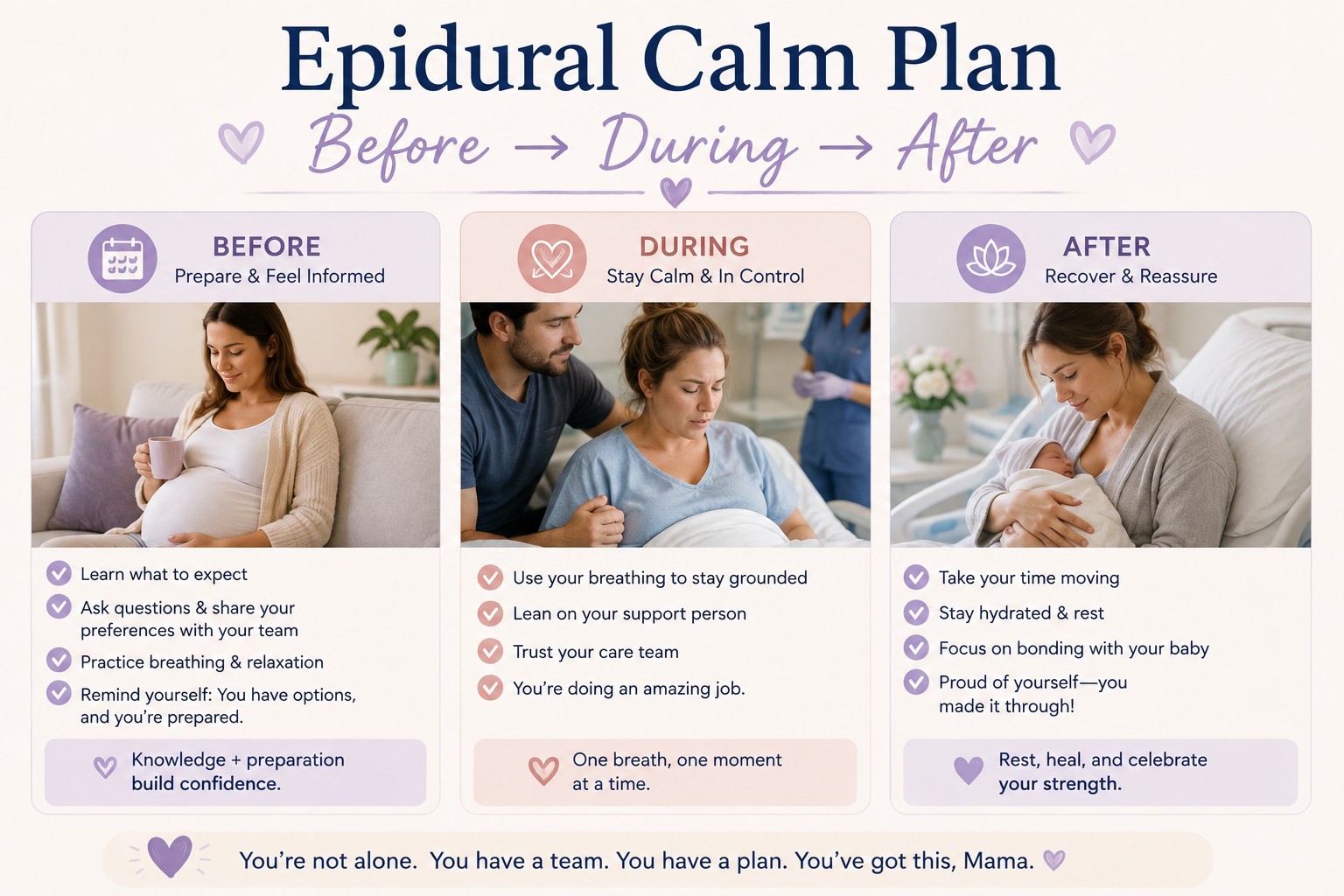
You may already have a birth plan.
Consider creating a tiny plan specifically for the possibility of an epidural.
It doesn't need to be complicated.
Before: Tell the healthcare team I'm anxious about the epidural.
During: Avoid looking at the equipment if that increases my anxiety. Listen to the instructions I'm being given.
Support: Focus on my partner's voice or another calming point of attention.
Mental focus: Return to my breathing or a calming practice I've already used during pregnancy.
After: Tell my healthcare team if I'm experiencing significant pain or something doesn't feel right.
The purpose isn't to control exactly what happens.
It's to reduce the number of things your anxious mind has to figure out in the moment.
Instead of:
"What do I do?"
you already know:
"This is where I'm going to put my attention."
The middle of active labor isn't necessarily the easiest time to try a calming technique for the first time.
Practice beforehand.
That might mean slowing your breathing, relaxing your jaw and shoulders, focusing on one point, listening to guided support, or practicing bringing your attention back when your thoughts begin racing.
This is also where MamaZen's Active Labor: Epidural Mindpower Session can become part of your birth preparation.
You can listen to the session during pregnancy so the guidance and experience become familiar before labor.
Then, if you choose an epidural during labor and circumstances allow, you can return to the session when you need that support.
Instead of trying to figure out how to calm yourself while you're already experiencing contractions and anticipating the procedure, you have something you've practiced before.
A familiar voice.
A familiar focus.
A familiar way of redirecting your attention.
The goal isn't to convince yourself that you won't be nervous.
It's to practice what you'll do when nervousness appears.
You can prepare extensively and still experience a sudden wave of fear when the moment actually arrives.
That doesn't mean your preparation failed.
If you feel panic rising, tell your healthcare team.
Then try to make the moment smaller.
Anxiety wants you to think about everything simultaneously:
The needle.
The contraction.
Possible side effects.
The rest of labor.
Pushing.
Your baby.
Whether you're making the right decision.
You don't need to solve all of those things in this one moment.
Come back to the next thing you actually need to do.
Listen to the instruction you're being given.
Focus on one breath.
Notice the voice you've chosen to listen to.
Let your healthcare team manage the medical procedure while you focus on getting through this moment.
If your thoughts race ahead again, bring them back again.
The goal isn't perfect calm.
It's having somewhere useful to return your attention.
The epidural itself may happen once.
Anxiety can make you experience an imaginary version of it hundreds of times beforehand.
Every time the thought appears, you mentally enter the delivery room.
You picture the needle.
You imagine moving.
You imagine something going wrong.
Your body tenses.
You search for reassurance.
You feel better temporarily.
Then the thought returns and the cycle begins again.
Your mind may believe it's preparing you.
But repeatedly rehearsing the worst possible outcome isn't the same as useful preparation.
Once you've gathered the information you need, spoken with your healthcare provider, and made a plan, notice when you're trying to solve the same hypothetical situation again.
You might remind yourself:
"I've already thought about this. I know what my plan is. I don't need to solve it again right now."
Then bring your attention back to what's actually happening around you.
You're not ignoring the epidural.
You've prepared for it.
There's a difference.
You can prepare for an unmedicated birth and still learn about epidurals.
Those two things don't contradict each other.
Sometimes fear surrounding an epidural becomes stronger because you've attached meaning to whether or not you receive one.
"If I get an epidural, I failed."
"I should be able to handle labor without it."
"Everyone knows I wanted an unmedicated birth."
"I'll be disappointed in myself if I change my mind."
Your birth doesn't need to become a test of your strength.
You can have preferences without turning those preferences into rules you must follow regardless of how your labor unfolds.
If you decide you want an epidural, that decision doesn't erase everything you did before that moment.
And if you decide you don't want one, you can continue with the pain-management strategies you've discussed with your healthcare team.
Talk with your provider before labor about your options and any medical or timing considerations that might affect them.
The goal isn't to prove that one type of birth is better than another.
It's to feel informed and supported enough to make decisions as your actual labor unfolds.
Yes.
Understanding the possibility doesn't mean you're planning for it to happen.
You can prefer an unmedicated birth while still understanding your pain-management options.
Think of it as having more than one possible path.
Your preferred path may be:
Labor without an epidural.
And your alternative may be:
If I decide I want an epidural, I understand the basic process and already know how I want to support myself through it.
Having an alternative plan doesn't make your preferred birth less meaningful.
It simply means that if your plans change, you aren't trying to process completely unfamiliar information in the middle of labor.
Sometimes epidural anxiety isn't an isolated fear.
It's one piece of a much larger fear of labor or giving birth.
Maybe you're also scared of contractions.
You worry about tearing.
You worry about pushing.
You worry about needing an induction or C-section.
You worry about losing control.
You worry you'll panic.
And the epidural becomes another item your mind adds to a growing list of things that could happen.
Ask yourself:
If the epidural weren't part of birth, would I still be scared?
If the answer is yes, addressing the epidural alone may not address the underlying anxiety.
Otherwise, fear can simply move.
You finally feel better about the epidural...
and suddenly you're worried about pushing.
You become reassured about pushing...
and now you're worried about an emergency intervention.
The subject changes, but the underlying cycle remains.
This is where broader preparation for fear of giving birth can be helpful: understanding the birth process, talking through concerns with your healthcare provider, preparing for different possibilities, and practicing ways to respond when anxious thoughts appear.
Some nervousness about childbirth and medical procedures is understandable.
But if fear of the epidural or giving birth is consuming large portions of your day, interfering with sleep or daily functioning, causing intense distress, or making you avoid medical care, tell your healthcare provider.
Be specific about how much the fear is affecting you.
You don't have to wait until labor to bring it up.
Your provider can discuss your individual circumstances and help you determine what additional support may be appropriate.
Fear of needles, medical procedures, unfamiliar sensations, possible complications, or loss of control can all contribute to epidural anxiety. If your fear is significantly affecting your pregnancy or daily life, discuss it with your healthcare provider.
Tell your healthcare team if this is something you're particularly worried about. They will give you instructions about positioning during the procedure. You can also ask your provider beforehand what generally happens if you experience a contraction during epidural placement.
Fear of needles doesn't automatically determine whether you can receive an epidural. Tell your healthcare team about your fear so you can discuss ways to make the experience more manageable.
If seeing needles or medical equipment increases your anxiety, tell your healthcare team that you would prefer not to see the equipment.
Pain relief can vary. If you continue experiencing significant pain or the epidural seems uneven, tell your healthcare team so they can assess what's happening and determine what steps may be appropriate.
Birth preferences can change. Talk with your healthcare provider before labor about the pain-management options available to you and any individual medical or timing considerations.
It may help to tell your healthcare team you're anxious, focus on one instruction or breath at a time, use support from your partner or birth team, avoid looking at equipment if that increases your fear, and practice calming techniques before labor.
MamaZen's Active Labor: Epidural Mindpower Session can also be practiced during pregnancy so you have familiar guided support to return to around the epidural experience.
You might still feel nervous when labor begins.
You might still feel your heart beat faster when you decide it's time for an epidural.
Preparation doesn't necessarily mean reaching a point where nothing scares you.
It means understanding more about what to expect, knowing which questions you want to ask, knowing how you want to communicate with your healthcare team, and having tools you can return to when anxiety gets louder.
If you choose an epidural, you can take the experience one moment at a time.
One breath.
One instruction.
One contraction.
One moment of focus.
You don't have to predict every part of your birth.
You can prepare yourself to meet it as it comes.
Prepare your mind for labor with MamaZen's Active Labor: Epidural Mindpower Session →
Irin Rubin is the CEO and co-founder of MamaZen and the author of The MamaZen Method. Inspired by her own experience with pregnancy and postpartum anxiety, she has spent years developing mindfulness and cognitive hypnotherapy programs that support emotional well-being during pregnancy, birth, postpartum, and parenting.


Science-based Mindpower Sessions® help you create lasting change for you and your family.

Get instant relief right when you need it with our 5-7 Minute Emergency Sessions.

Empowering Kids to conquer anxiety, build confidence, and foster positive self-talk.

Supporting and guiding you through every step of parenthood.
Get expert tips to raise confident kids.
Enter email for access!