
Your heart suddenly starts racing.
You feel like you can't catch your breath.
Your chest feels tight.
Your hands begin to shake.
A wave of fear rushes over you, and your first thought is:
"Something is wrong with me."
Then comes another terrifying thought:
"What if something is wrong with my baby?"
If you've experienced something like this during pregnancy, you're not alone.
Panic attacks during pregnancy can feel overwhelming and frightening, especially if you've never had one before. Many expecting moms worry they're having a medical emergency or that the panic itself could harm their baby.
The good news is that panic attacks are a common experience for some people during pregnancy. Understanding what's happening in your body can help reduce some of the fear and make it easier to respond calmly if another panic attack occurs.
At the same time, it's important to remember that many symptoms of a panic attack—such as chest discomfort, shortness of breath, dizziness, or a racing heart—can also have other medical causes during pregnancy. If your symptoms are new, severe, persistent, or concerning, or you're unsure what's causing them, contact your healthcare provider or seek emergency medical care right away.
A panic attack is a sudden episode of intense fear or discomfort that comes on quickly and usually reaches its strongest point within minutes.
Unlike everyday stress or worry, a panic attack can feel as though it appears out of nowhere. Even when there isn't an actual emergency, your brain and body react as though you're facing immediate danger.
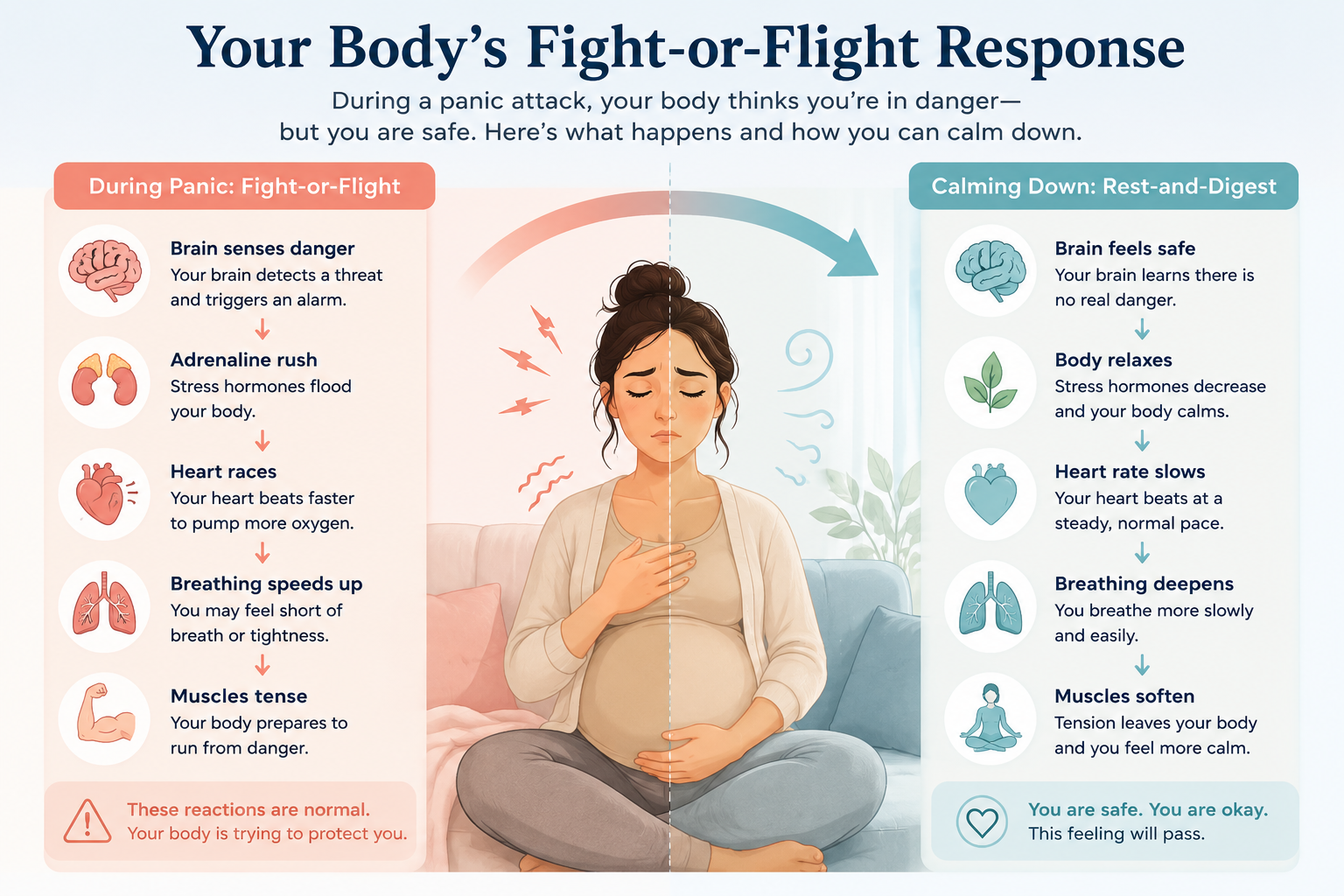
During a panic attack, your body's natural fight-or-flight response becomes activated.
This survival system is designed to protect you from real threats. It prepares your body to react by increasing your heart rate, changing your breathing, and releasing stress hormones that help you respond quickly.
The challenge is that during a panic attack, this alarm system can activate even when you're safe.
That can make the experience incredibly convincing.
Many women describe feeling certain that they're having a heart attack, passing out, or that something is seriously wrong with their pregnancy.
Although these sensations are very real, the feelings themselves don't necessarily mean that a dangerous event is happening. Because some serious pregnancy-related conditions can cause similar symptoms, it's always appropriate to seek medical evaluation if you're uncertain or if symptoms are severe or unusual for you.
Pregnancy doesn't necessarily cause panic attacks, but the physical and emotional changes that come with pregnancy may make them more likely for some people.
Growing a baby involves enormous changes throughout your body.
Your hormones shift.
Your sleep often becomes lighter and more interrupted.
Your heart works harder to support both you and your growing baby.
You may notice physical sensations you've never experienced before, including a faster heartbeat, shortness of breath with activity, dizziness, or changes in body temperature.
For someone who is already feeling anxious, these normal changes can sometimes be interpreted as signs that something is wrong.
That interpretation can trigger even more fear, which increases the body's stress response, creating a cycle that may develop into a panic attack.
Several factors may contribute to panic attacks during pregnancy, including:
Having panic attacks during pregnancy does not mean you're weak or that you're doing anything wrong.
It also doesn't mean you'll continue having panic attacks after your baby is born.
Many women experience panic symptoms only during a particular stage of pregnancy, while others find that their symptoms improve with support, stress management, and guidance from their healthcare provider.
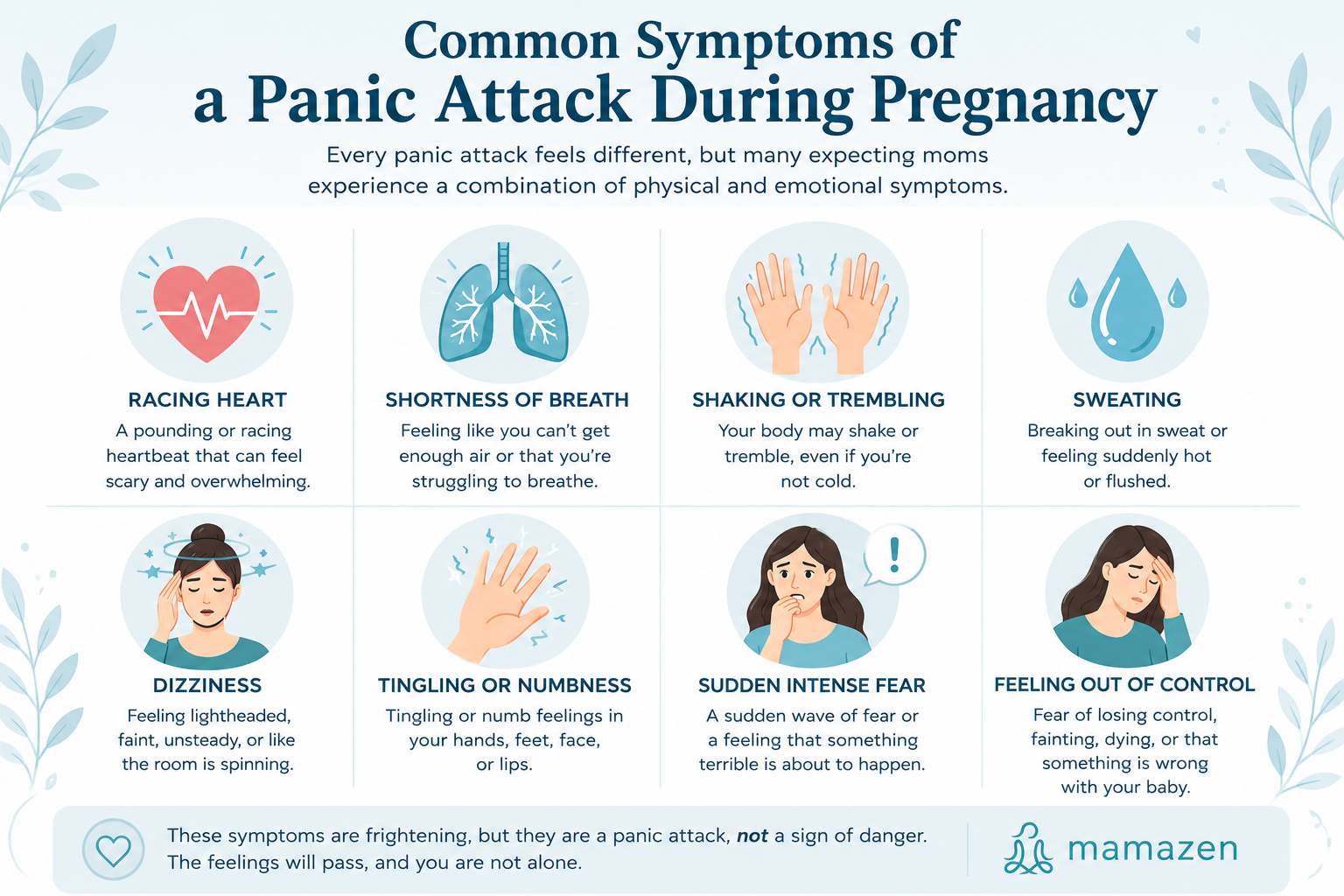
Every panic attack feels a little different, but many expecting mothers experience a combination of physical and emotional symptoms.
Common physical symptoms include:
Many women also experience emotional symptoms, including:
One of the most difficult parts of a panic attack is how suddenly it can appear.
You might be folding baby clothes.
Driving to work.
Waiting for an ultrasound appointment.
Trying to fall asleep.
Or simply sitting on the couch when, within minutes, your body feels completely out of control.
That sudden change is one reason panic attacks can feel so frightening.
One reason panic attacks are especially confusing during pregnancy is that many symptoms overlap with normal pregnancy changes.
For example, pregnancy itself can sometimes cause:
A panic attack can include many of these same sensations, but they're often accompanied by an intense wave of fear and tend to build rapidly over a short period of time.
Rather than trying to diagnose yourself, it's safest to pay attention to the whole picture.
If your symptoms are unusual for you, are severe, don't improve, or you're worried about what you're experiencing, contact your healthcare provider promptly. It's always appropriate to seek medical care if you're concerned that your symptoms could be related to your pregnancy or another medical condition.
One of the hardest things about a panic attack is that it doesn't feel like "just anxiety."
It feels real because your body is producing a very real physical response.
When your brain believes there's danger—even if there isn't—it activates your nervous system almost instantly.
Stress hormones are released.
Your breathing changes.
Your heart beats faster to move blood to your muscles.
Your muscles tense.
Your senses become more alert.
From your body's perspective, it's preparing you to survive.
The problem is that your brain has mistaken fear for danger.
Instead of responding to a genuine emergency, it's responding to anxious thoughts or physical sensations that have been interpreted as threatening.
Once you understand that this is your body's protective system working overtime, the experience often becomes a little less mysterious. While that understanding doesn't make a panic attack disappear instantly, it can help reduce the fear that keeps the cycle going.
Not every panic attack has an obvious cause.
Sometimes they seem to happen completely out of nowhere.
Other times, they develop after a stressful event, a worrying thought, or even a completely normal physical sensation that your brain mistakenly interprets as danger.
Understanding your personal triggers can help you recognize patterns and feel more prepared if panic starts to build.
Pregnancy changes the way many women think.
Your mind naturally becomes focused on protecting your baby.
You may find yourself asking questions like:
These thoughts are incredibly common.
Your brain is trying to keep your baby safe.
The problem is that anxiety often treats uncertainty as danger.
Because pregnancy involves months of waiting and unknowns, your brain may continue searching for reassurance that never feels quite complete.
As your due date gets closer, it's normal to think more about labor.
Some moms worry about:
For some women, these fears stay in the background.
For others, they become overwhelming enough to trigger panic symptoms.
Learning more about birth, practicing relaxation techniques, and discussing your concerns with your healthcare provider can help make labor feel less unpredictable.
Pregnancy comes with many new sensations.
Your heart may beat faster.
You may become short of breath walking upstairs.
Your belly tightens as it grows.
You may feel dizzy if you stand too quickly.
These changes are often normal, but if you've experienced anxiety before, your brain may become hyperaware of every sensation.
For example:
You notice your heart beating faster.
You wonder why.
You begin worrying that something is wrong.
Your anxiety increases.
Your heart beats even faster.
Now your brain sees this as proof that something dangerous is happening.
This creates a cycle where fear fuels physical symptoms, and physical symptoms fuel more fear.
Sleep and anxiety are closely connected.
Unfortunately, pregnancy doesn't always make sleep easy.
Between frequent bathroom trips, heartburn, discomfort, vivid dreams, and finding a comfortable position, many expecting mothers get less sleep than they need.
When you're exhausted, your nervous system has a harder time managing stress.
Small worries can feel much bigger.
Physical sensations feel more intense.
You may also be more emotionally sensitive, making panic attacks more likely for some people.
Pregnancy often brings significant changes beyond your growing baby.
You may be preparing a nursery.
Moving to a new home.
Managing finances.
Balancing work responsibilities.
Adjusting relationships.
Preparing older children for a new sibling.
Even positive life changes create stress.
When many stressors build up at once, your nervous system may become more reactive.
When panic hits, your instinct may be to make it stop as quickly as possible.
Ironically, fighting the panic often makes it feel stronger.
Instead, the goal is to help your nervous system recognize that you're safe.
These techniques won't necessarily make a panic attack disappear instantly, but many people find they help reduce its intensity and shorten how long it lasts.
The first step is naming the experience.
You might quietly tell yourself:
"This feels frightening, but it may be a panic attack."
Or:
"My body is responding to fear. This feeling will pass."
Simply recognizing what's happening can interrupt the cycle of fear feeding more fear.
During panic, breathing often becomes fast and shallow.
This can increase feelings of dizziness, tingling, and chest tightness.
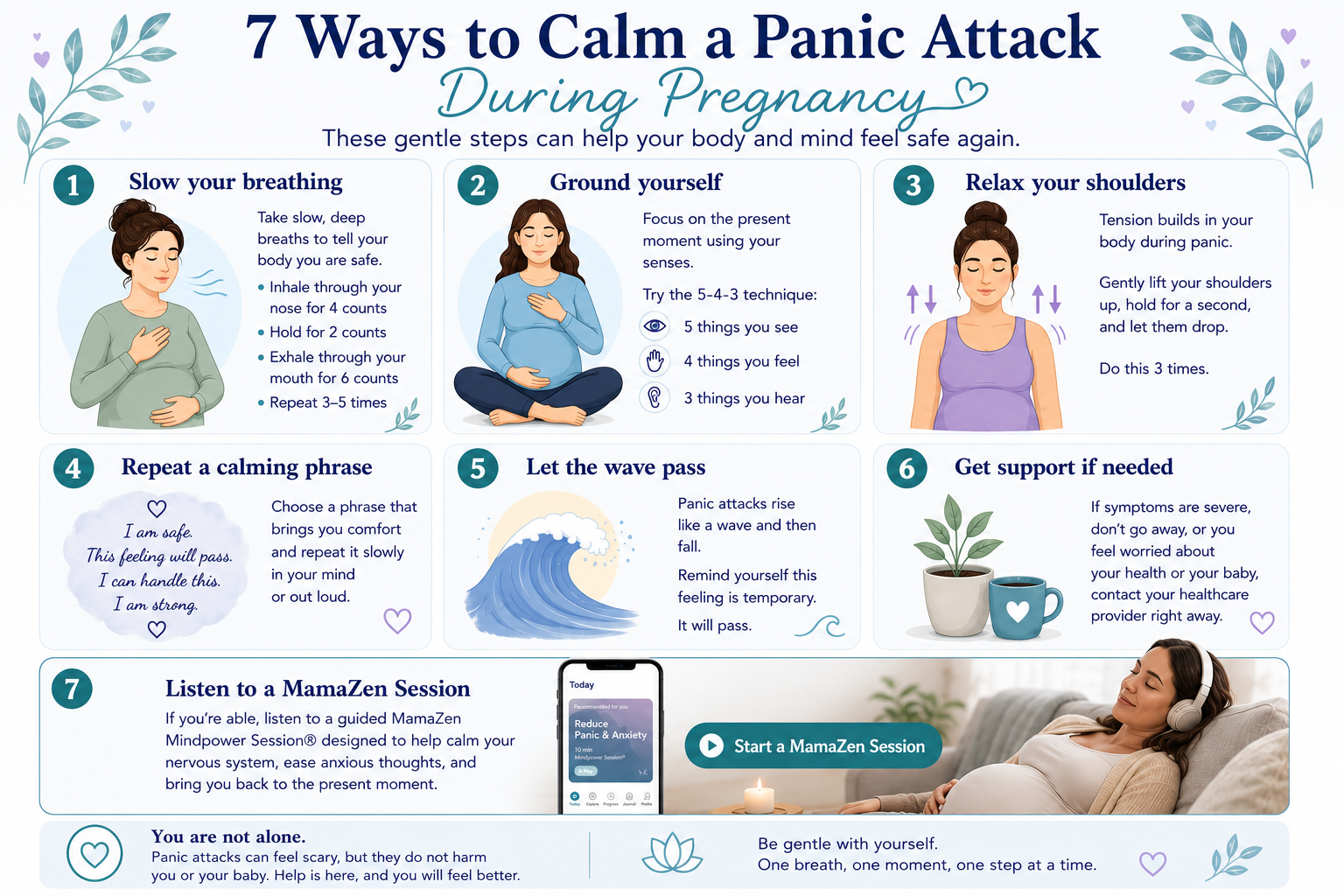
Instead of taking large deep breaths, focus on slow, gentle breathing.
Try this simple pattern:
Longer exhalations encourage your body to shift away from fight-or-flight and toward a calmer state.
If counting feels stressful, simply focus on making your exhale a little longer than your inhale.
If you think your symptoms could be caused by a medical emergency or a pregnancy complication, seek emergency medical care rather than assuming it's a panic attack.
Panic pulls your attention toward frightening "what if" thoughts.
Grounding techniques help bring your focus back to what's happening right now.
One helpful exercise is the 5-4-3-2-1 technique.
Notice:
This simple exercise encourages your brain to reconnect with your surroundings instead of your anxious thoughts.
Many people don't realize how much tension they're holding during a panic attack.
Take a moment to notice your shoulders.
Are they lifted toward your ears?
Is your jaw clenched?
Are your fists tight?
Slowly release each area.
Drop your shoulders.
Relax your jaw.
Unclench your hands.
Soften your forehead.
Even small changes in muscle tension can send calming signals back to your nervous system.
A simple phrase can help interrupt catastrophic thinking.
You might repeat:
Choose one that feels believable to you.
The goal isn't to convince yourself everything is perfect.
It's simply to offer your mind a calmer place to focus.
Panic often feels like it will last forever.
In reality, the most intense part of a panic attack usually passes with time.
Imagine panic as an ocean wave.
You don't have to stop the wave.
You simply allow it to rise, crest, and gradually fall.
Resisting every sensation often increases fear.
Allowing the feelings to come and go without judging them can reduce the cycle that keeps panic going.
There's no guaranteed way to prevent panic attacks, but many women find they become less frequent when they consistently support their physical and emotional well-being.
Helpful habits include:
It's also helpful to notice patterns.
Do panic attacks happen after scrolling social media?
Late at night?
When you're overly tired?
Recognizing your own triggers doesn't mean you can prevent every panic attack, but it can help you respond with greater confidence instead of surprise.
One thing many expecting mothers discover is that constantly searching for reassurance online doesn't always bring lasting relief.
You might feel calmer for a few hours after reading an article or asking a question in a forum.
Then another worry appears.
This happens because anxiety is often searching for certainty, and pregnancy naturally comes with uncertainty.
Rather than trying to eliminate every unknown, learning to tolerate uncertainty while caring for yourself can be a more sustainable path toward feeling calmer throughout pregnancy.
One of the biggest challenges during pregnancy is that panic attack symptoms can overlap with symptoms of other medical conditions.
If you've experienced panic attacks before, you may recognize the familiar pattern.
However, if this is your first panic attack—or if your symptoms feel different than usual—it's important not to assume anxiety is the cause.
Contact your healthcare provider promptly if you experience:
It's always appropriate to call your healthcare provider if you're unsure what's causing your symptoms. They can help determine whether your symptoms are related to anxiety, pregnancy, or another medical condition that needs evaluation.
An occasional panic attack can be frightening.
But if panic attacks become frequent or begin affecting your daily life, it's important to let your healthcare provider know.
You don't have to wait until your next routine prenatal appointment if you're struggling.
Reach out sooner if panic attacks are:
Your healthcare provider can discuss treatment options that are appropriate for your individual situation.
For some women, counseling or cognitive behavioral therapy (CBT) may be helpful. Others may benefit from additional support depending on the severity of their symptoms and their medical history. Your provider can help you decide what approach is best for you.
One of the hardest parts of panic attacks is worrying about when the next one might happen.
You may find yourself avoiding certain places or situations because you're afraid another panic attack will occur.
Over time, that fear can become almost as stressful as the panic attacks themselves.
Instead of focusing on preventing every anxious feeling, try building confidence in your ability to respond.
Remind yourself:
Some women find that as they become less fearful of the panic itself and develop coping strategies, the panic becomes less intense or less disruptive over time.
Progress doesn't always mean never feeling anxious again.
Sometimes progress means trusting yourself to handle anxious moments with greater calm and self-compassion.
Pregnancy comes with plenty of waiting.
Waiting for appointments.
Waiting for ultrasound results.
Waiting to feel your baby move.
Waiting to meet your little one.
Between those milestones, anxious thoughts can sometimes feel overwhelming.
Many expecting moms find it helpful to have calming support available whenever they need it.
MamaZen offers short, pregnancy-specific mindfulness and cognitive hypnotherapy sessions designed to help you relax, quiet racing thoughts, and feel more emotionally grounded throughout pregnancy.
Whether you're feeling anxious before an appointment, struggling to fall asleep after a stressful day, or simply looking for a few peaceful minutes to reconnect with yourself, guided relaxation can become part of your daily routine.
While MamaZen isn't a substitute for medical care or mental health treatment, many moms appreciate having practical tools to support their emotional well-being between healthcare visits.

Hormonal changes during pregnancy may affect mood and emotions, and some people notice increased anxiety during this time. While hormones alone don't necessarily cause panic attacks, they may contribute alongside other factors such as stress, lack of sleep, previous anxiety, and the uncertainty that often comes with pregnancy.
Panic attacks often reach their most intense point within minutes. Some people feel better shortly afterward, while others continue to feel tired, emotionally drained, or anxious for a longer period.
Yes. Some pregnant women notice panic attacks or intense anxiety after going to bed or waking suddenly during the night. As the day quiets down, anxious thoughts can become more noticeable, making nighttime a common time for panic symptoms to occur.
Yes. Some women experience their first panic attack during pregnancy, while others have had panic attacks before becoming pregnant. Either way, it's important to discuss new symptoms with your healthcare provider to make sure they aren't caused by another medical condition.
People often use these terms interchangeably, but "panic attack" has a more specific medical definition. Panic attacks typically involve a sudden surge of intense fear and physical symptoms that peak within minutes, while anxiety often builds more gradually.
Because panic attacks can closely resemble serious medical conditions, seek emergency medical care if you're experiencing severe chest pain, significant difficulty breathing, loss of consciousness, severe pregnancy-related symptoms, or if you're uncertain whether your symptoms are due to a panic attack. It's safer to be evaluated than to assume anxiety is the cause.
Experiencing panic attacks during pregnancy doesn't necessarily predict what labor will be like. Many women who experience pregnancy anxiety go on to have positive birth experiences. If you're worried about labor anxiety, discuss your concerns with your healthcare provider during your prenatal visits.
There isn't a guaranteed way to prevent every panic attack. However, many women find that getting adequate rest, practicing relaxation techniques, eating regular meals, staying hydrated, seeking emotional support, and addressing anxiety early can help reduce how often panic attacks occur.
A panic attack can make you feel as though you're completely alone.
In those moments, it's easy to believe that no one else could possibly understand what you're experiencing.
But many expecting mothers have sat exactly where you are.
They've felt their heart race.
They've worried that something terrible was happening.
They've questioned whether they would ever feel calm again.
With the right support, many women learn to understand their anxiety, respond to it with greater confidence, and experience more moments of peace during pregnancy.
If panic attacks are becoming frequent or interfering with your daily life, don't hesitate to talk with your healthcare provider. You deserve support, and help is available.
Pregnancy is filled with uncertainty, but it can also be filled with resilience, growth, and moments of calm.
One breath.
One moment.
One day at a time.
Sources
Irin Rubin is the CEO and co-founder of MamaZen and the author of The MamaZen Method. Inspired by her own experience with pregnancy and postpartum anxiety, she has spent years developing mindfulness and cognitive hypnotherapy programs that support emotional well-being during pregnancy, birth, postpartum, and parenting.


Science-based Mindpower Sessions® help you create lasting change for you and your family.

Get instant relief right when you need it with our 5-7 Minute Emergency Sessions.

Empowering Kids to conquer anxiety, build confidence, and foster positive self-talk.

Supporting and guiding you through every step of parenthood.
Get expert tips to raise confident kids.
Enter email for access!