
If you're scared to give birth, you are far from the only one.
You might be excited to meet your baby and still have moments when the thought of actually giving birth feels overwhelming.
Maybe you find yourself thinking:
"What if I can't handle the pain?"
"What if something goes wrong?"
"What if I panic?"
"What if I need an emergency C-section?"
"What if I lose control?"
Or maybe you can't even pinpoint exactly what you're afraid of. You just know that as your due date gets closer, giving birth starts to feel more real—and so does the fear.
Fear of giving birth can range from occasional nervousness to intense anxiety that occupies your thoughts throughout the day. Some women feel relatively calm during most of pregnancy and notice their fear increasing during the third trimester. Others worry about childbirth from the very beginning.
You can also feel two completely different things at once.
You can desperately want to meet your baby and wish you could somehow skip the part where you have to give birth.
You can feel grateful for your pregnancy and terrified of labor.
You can want a baby more than anything and still be frightened by what your body is about to experience.
Being afraid of giving birth doesn't mean you aren't ready to become a mother. And fear itself doesn't predict what your birth experience will be like.
Understanding where the fear is coming from can be an important first step toward feeling more prepared for the experience ahead.
Childbirth asks you to approach something enormously important without knowing exactly how it will unfold.
You may know approximately when your baby will arrive, but not exactly when labor will begin.
You can create a birth plan, but you can't predict every decision you'll need to make.
You can learn about contractions, but you don't know exactly how they will feel in your body.
You can choose the hospital and your care team, but you still can't know precisely what your birth experience will look like.
That uncertainty can be difficult, especially if you tend to feel calmer when you know what to expect.
Your mind may respond by trying to prepare for every possible outcome.
Instead of simply thinking:
"I wonder what labor will be like."
Your thoughts may jump to:
"What if something goes wrong?"
And then:
"What would happen if that happened?"
And then:
"What if they couldn't fix it?"
Before you realize it, you've mentally traveled from a normal uncertainty about childbirth to the most frightening outcome your mind can imagine.
That's one reason fear of labor can feel so powerful. You're preparing for an experience you can't completely predict or control.
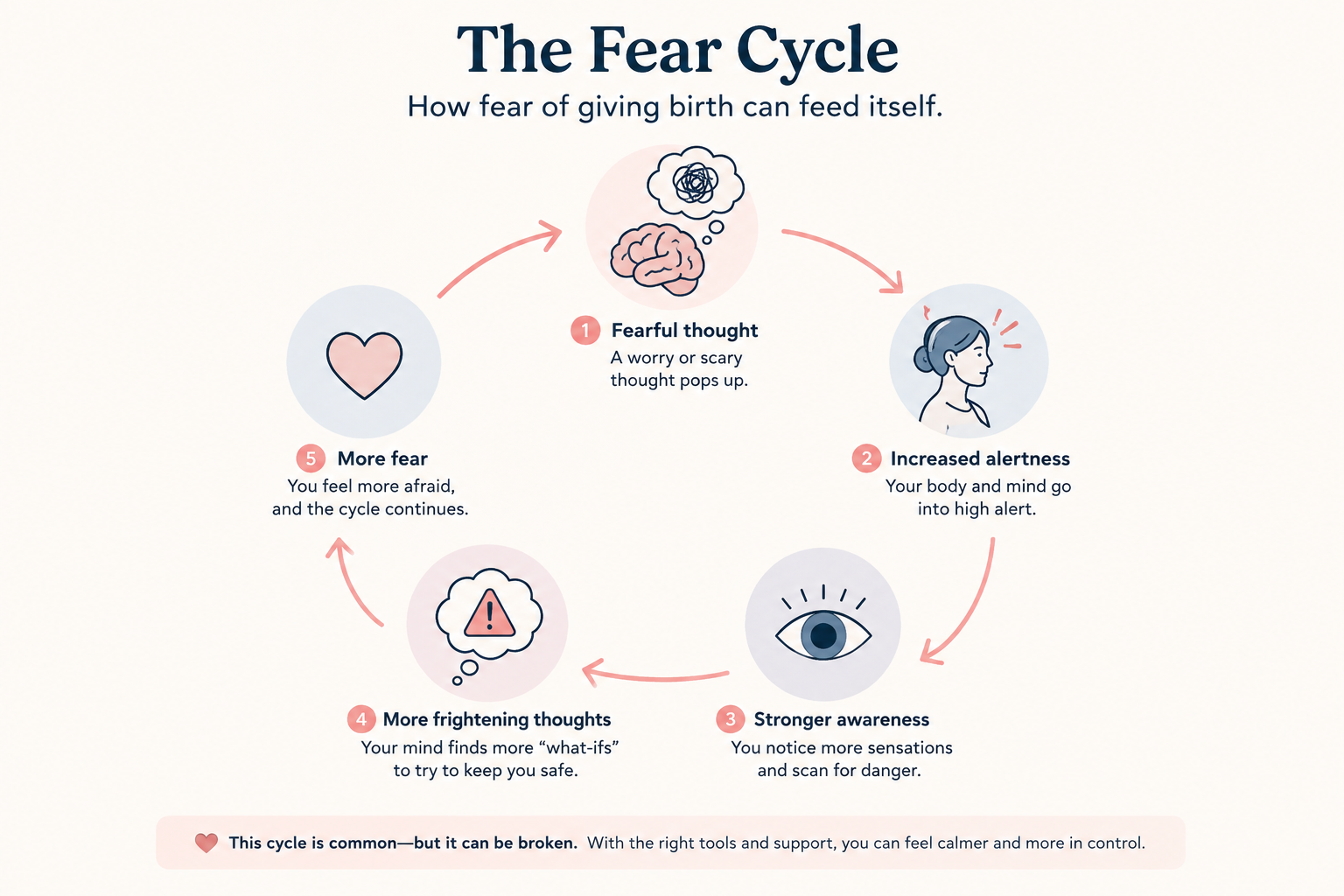
Fear doesn't always stay inside your thoughts.
Imagine you're lying in bed thinking about labor.
A thought appears:
"What if I can't handle it?"
Your body may become more alert.
You notice your heart beating.
Your muscles feel tense.
You become more aware of every sensation in your body.
Then your mind notices those sensations too.
"Why do I feel so anxious?"
And suddenly, the fact that you're afraid becomes another reason to be afraid.
The cycle can look something like this:
Fearful thought → increased alertness → stronger awareness of sensations → more frightening thoughts → more fear
This is one reason repeatedly telling yourself to "stop worrying" doesn't always work.
Instead, it can be helpful to learn how to notice when the cycle is beginning and practice ways to bring your attention back to the present.
That doesn't mean ignoring genuine pregnancy symptoms or medical concerns. If you experience symptoms that concern you, changes in your baby's usual movement pattern, signs of labor, or anything else you're unsure about, contact your healthcare provider for guidance.
But when the problem is your mind repeatedly taking you into imagined future scenarios, learning how to interrupt that pattern can become part of preparing emotionally for birth.
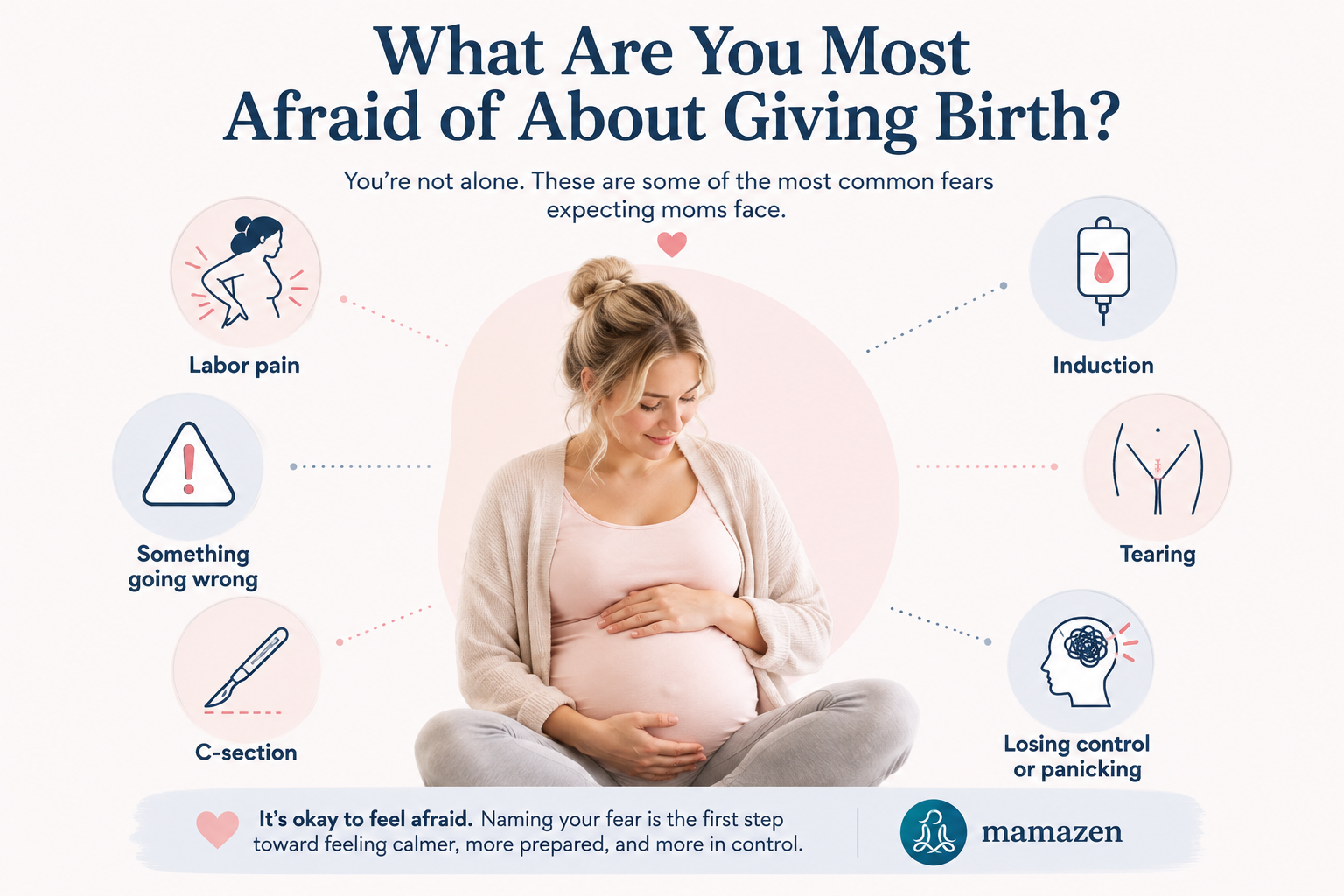
There isn't one single fear of childbirth.
For many women, "I'm scared to give birth" is actually several different fears bundled together.
You might be afraid of:
Sometimes identifying the specific fear underneath "I'm scared to give birth" can make the anxiety feel less enormous.
Instead of facing one giant, undefined threat called childbirth, you can begin looking at the individual concerns that are making childbirth feel frightening.
And different fears need different kinds of preparation.
If your biggest fear is pain, learning about labor and pain-management options may help.
If you're afraid of losing control, practicing ways to respond when anxiety rises may be more useful.
If you're afraid of an induction or C-section, talking through when those interventions may be recommended with your healthcare provider can give you information specific to your pregnancy.
You don't have to solve every possible childbirth scenario.
Start with the fear that's taking up the most space.
Some fear or nervousness about childbirth can be understandable, particularly when you're approaching birth for the first time.
Giving birth is a major physical and emotional experience. Even women who feel prepared can have moments of uncertainty.
The important question isn't necessarily whether you experience fear.
It's how much the fear is affecting you.
You might notice that thoughts about birth come up occasionally, but you're still able to enjoy your pregnancy, prepare for your baby, sleep, work, and think about other things.
Or the fear may begin taking up significantly more space.
You may find yourself repeatedly searching childbirth complications online, watching birth videos for reassurance, asking the same questions after you've already received reassuring answers, avoiding conversations about birth altogether, or lying awake imagining everything that could go wrong.
If fear about childbirth is becoming persistent, overwhelming, or interfering with your daily life, consider discussing it with your OB-GYN, midwife, or a qualified mental health professional.
You don't have to wait until the fear becomes unbearable before asking for support.
You may come across the term tokophobia when researching fear of giving birth.
Tokophobia generally refers to a severe or intense fear of pregnancy or childbirth that can cause significant distress. It goes beyond the nervousness many expecting mothers experience when thinking about labor and delivery.
Tokophobia is sometimes described as primary when severe childbirth fear occurs in someone who hasn't previously given birth, and secondary when it develops following a previous difficult or traumatic birth experience.
Reading about tokophobia online doesn't mean you should diagnose yourself.
If your fear of childbirth feels extreme, is affecting your daily life, or is influencing important decisions about your pregnancy or birth, talk with your healthcare provider or a qualified mental health professional who can help you understand what you're experiencing.
You might have spent the first and second trimesters thinking about birth as something far in the future.
Then suddenly you're 30 weeks.
Then 34.
Then 37.
The car seat is installed.
Your hospital bag is packed.
People start texting you asking whether you're "ready."
Birth stops being an abstract event and becomes something that could happen very soon.
That shift alone can make fear feel stronger.
You may also start paying much closer attention to your body.
"Was that a contraction?"
"Does that pressure mean labor is starting?"
"What if my water breaks tonight?"
"Will I know when it's time to go to the hospital?"
When you're already anxious about giving birth, unfamiliar sensations can quickly become another reason for your mind to ask, "What if?"
When you're afraid, searching for information can feel like preparation.
Sometimes it is.
Understanding your options, learning about labor, and discussing questions with your care team can help you feel more informed.
But there can be a point where information seeking turns into reassurance seeking.
You read one reassuring article.
You feel better.
Then you see a frightening birth story.
So you search again.
You find another reassuring answer.
Then another "what if?" appears.
Soon you've spent an hour trying to achieve something the internet can't give you:
complete certainty about how your birth will unfold.
You don't need to know every possible thing that could happen during childbirth to feel prepared.
You need enough reliable information to understand your options, people you trust to help you navigate decisions, and tools that help you return to the present when your mind starts living inside a future that hasn't happened yet.
You may not be able to remove every nervous thought about childbirth.
And you don't necessarily need to.
The goal isn't to convince yourself that you know exactly how your birth will happen.
It's to begin replacing:
"I don't know what's going to happen, and I can't handle that."
with:
"I don't know exactly how this will happen, but I can prepare for it."
That may sound like a small difference, but it changes what you're asking of yourself.
You don't need certainty.
You need preparation, support, and tools you can use when fear appears.
Here are several ways to begin.
Start by finishing this sentence:
"When I imagine giving birth, I'm most afraid that..."
Try not to edit your answer.
Maybe it's:
"The pain will be unbearable."
"Something will happen to my baby."
"I'll panic and won't be able to calm down."
"I'll end up needing a C-section."
"I'll tear."
"My birth won't go according to plan."
"I won't be listened to."
Once you've identified the fear, you can decide what would actually help you feel more prepared for it.
If you're afraid of pain, you can learn about your pain-management options.
If you're afraid of an emergency C-section, you can ask your provider what circumstances might lead to one and what you could expect if it happened.
If you're afraid of panicking, you can begin practicing calming techniques before labor starts.
Specific fears can often be approached with specific preparation.
A birth plan can be useful.
But there's an important distinction between preparing for birth and trying to predict birth.
Preparation might look like:
"These are my preferences."
"These are the pain-management options I'm comfortable considering."
"This is who I want supporting me."
"These are questions I want to discuss with my provider."
Trying to predict or control every part of birth can sound more like:
"Labor has to happen this way."
"I can't have a C-section."
"I have to make it without an epidural."
"I need to know exactly what will happen."
That can create enormous pressure around an experience that isn't completely predictable.
Consider thinking about your birth plan as a set of preferences rather than promises.
You can know what you want while also leaving room to make new decisions based on what you and your medical team know in the moment.
Changing the plan doesn't mean you've failed at giving birth.
Flexibility can be part of preparation too.
Sometimes expecting mothers avoid certain questions because they're afraid the answers will make them more anxious.
But unanswered questions can leave plenty of room for your imagination to create its own answers.
Write your questions down before your next appointment.
You might ask:
"What happens when I first arrive at the hospital?"
"When should I call you or go in?"
"What pain-management options will be available?"
"Who will usually be in the room?"
"What happens if labor isn't progressing?"
"Under what circumstances might you recommend an induction or C-section?"
"How will decisions be explained to me during labor?"
"What can my partner do to support me?"
Your provider can answer questions based on your pregnancy, medical history, planned birth setting, and individual circumstances.
Sometimes knowing more about the process can feel more manageable than trying to predict the outcome.
For some women, when they say they're afraid of giving birth, what they're really afraid of is pain.
You may have heard people describe contractions as the worst pain they've ever experienced.
You may have watched dramatic birth scenes.
You may have heard frightening stories from friends or relatives.
And now your mind is trying to imagine a sensation you've never experienced.
Anticipating pain can sometimes become its own source of anxiety.
You aren't experiencing a contraction right now, but your mind can imagine one.
Then you imagine not coping with it.
Then you imagine hours of it.
Then you imagine yourself panicking.
Suddenly you're emotionally trying to get through an entire labor that hasn't started.
Instead of asking:
"Can I handle an entire labor?"
try bringing the question closer:
"What options and support will I have when labor happens?"
Talk with your healthcare provider about pain-management choices available in your planned birth setting. You can also learn coping strategies that may be used alongside whatever medical pain-management choices you make.
You don't need to decide that handling pain without medication makes you stronger.
And choosing pain relief doesn't make your birth less meaningful.
The goal is to understand your options so you can make informed decisions with your care team.
Another common fear isn't necessarily the contractions themselves.
It's:
"What if I lose control?"
You may worry that once labor begins you'll become overwhelmed, panic, forget everything you learned, or feel trapped.
If you've experienced anxiety or panic before, that possibility may feel especially frightening.
This is where preparing your mind before labor can become valuable.
Instead of expecting yourself to suddenly become calm in the middle of an intense experience, you can practice returning your attention to something simple:
One breath.
One contraction.
One instruction.
One moment.
You don't have to mentally manage the contraction that's coming an hour from now while you're experiencing this one.
You don't have to know how you'll feel at 8 centimeters when you're at 4.
And you don't need to know how you'll handle every moment of labor before labor begins.
You can practice meeting what's happening rather than everything your mind predicts might happen next.
The moment you're visibly pregnant, people may suddenly feel compelled to tell you exactly how they gave birth.
Some stories are beautiful.
Some are funny.
Some are frightening.
And some contain exactly the details you didn't want to hear while preparing for your own birth.
Someone else's birth story isn't a prediction of yours.
You are allowed to protect yourself from information that isn't helping you.
You can say:
"I'm trying not to hear difficult birth stories right now while I'm preparing for mine."
The same applies online.
If certain videos, forums, social media accounts, or birth stories consistently leave you more frightened than informed, consider stepping away from them.
Preparation should help you understand your options.
It doesn't require exposing yourself to every possible outcome.
When we think about preparing for childbirth, we often think about practical preparation:
Pack the hospital bag.
Install the car seat.
Take the birth class.
Choose the pediatrician.
Those things matter.
But you can prepare emotionally too.
If you know anxiety tends to make your thoughts race, practice what you'll do when that happens.
Maybe it's slowing your breathing.
Maybe it's focusing on what's happening right now instead of imagining the next five hours.
Maybe it's listening to a guided session.
Maybe it's repeating something simple:
"I only need to handle this moment."
The middle of labor doesn't have to be the first time you practice calming your mind.
This is also where MamaZen can become part of your birth preparation.
MamaZen's guided Mindpower Sessions for pregnancy are designed to help expecting mothers work with anxious thoughts, practice calming skills, and mentally prepare for birth.
Think of it the same way you might think about preparing your hospital bag.
You're creating tools you can reach for later.
You aren't practicing because you need to guarantee that you'll feel completely calm during labor.
You're practicing so that when fear appears, returning to calm feels more familiar.
If you've been overwhelmed by everything you're supposed to do before giving birth, keep your emotional preparation simple.
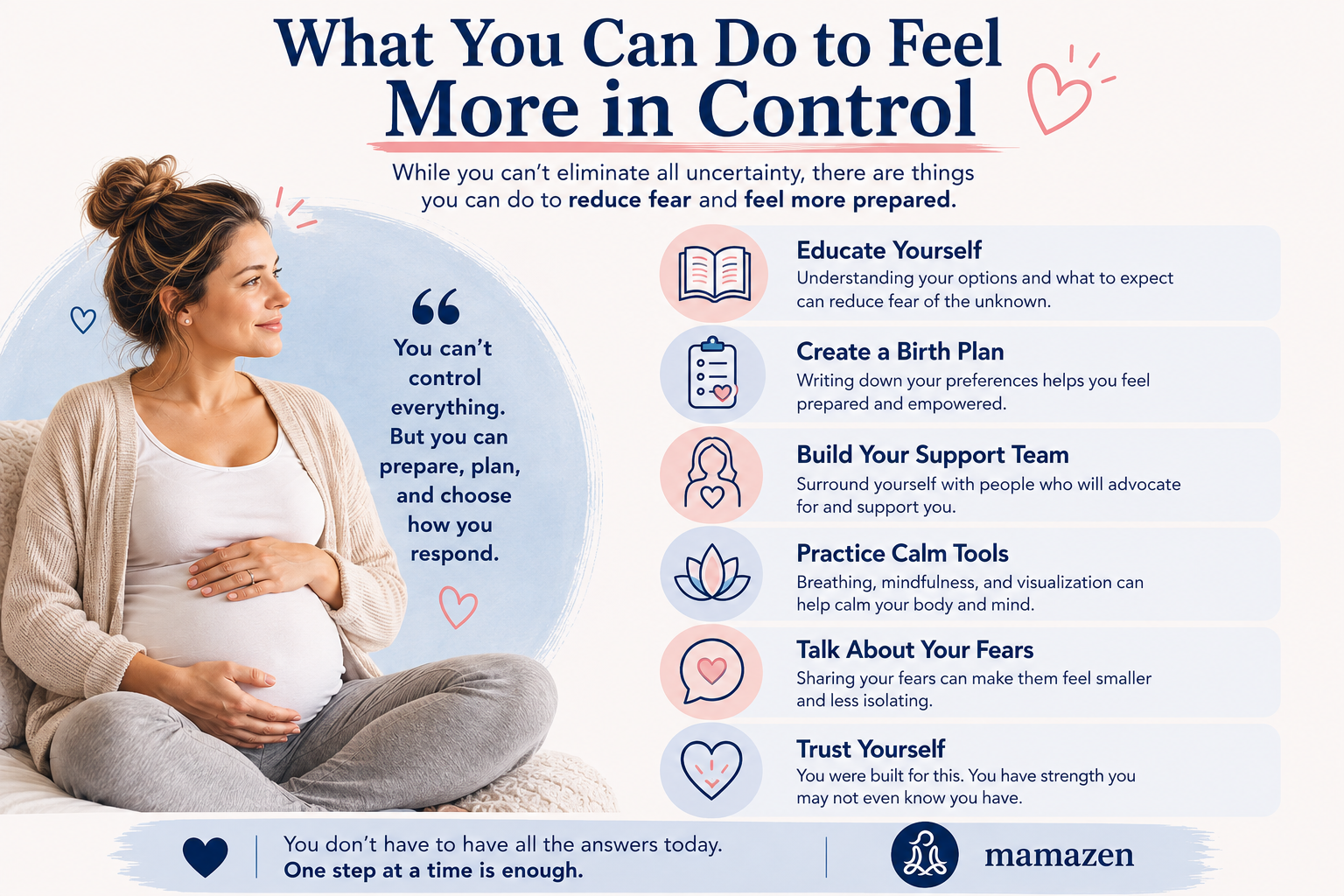
Write down the one thing about childbirth that's worrying you most right now.
Bring questions about your pregnancy, labor, procedures, pain management, or medical concerns to your healthcare provider rather than relying only on online searches or other people's experiences.
Learn about your planned birth setting, support people, pain-management choices, and birth preferences.
Have preferences without requiring your birth to follow one exact path.
Reduce exposure to birth stories or online content that repeatedly makes you more frightened without making you more informed.
Choose something simple enough that you'll actually use it: breathing, grounding, a guided MamaZen session, or another technique that works for you.
Discuss how you'd like them to help if you become frightened or overwhelmed during labor.
You don't have to prepare emotionally for every possible moment of childbirth today.
Prepare for the next step.
Then the next one.
One of the hardest parts of childbirth anxiety can be the mental images.
You may imagine yourself panicking.
You may picture an emergency.
You may mentally rehearse something happening to your baby.
And because the image feels frightening, your mind treats it as important.
So it shows it to you again.
When this happens, you don't have to argue with every thought or prove that the frightening scenario is impossible.
Instead, notice what your mind is doing:
"I'm imagining something that could happen. I'm not experiencing something that is happening."
Then bring yourself back to what you actually know right now.
Maybe right now you're sitting on your couch.
Your appointment went well yesterday.
Your healthcare provider hasn't told you there's an emergency.
You're thinking about birth.
You're not currently giving birth.
Returning to what is happening now can help interrupt the habit of emotionally living through frightening future scenarios before they've occurred.
This doesn't mean dismissing physical symptoms or medical concerns as anxiety. If you have concerns about symptoms, fetal movement, signs of labor, or your pregnancy, contact your healthcare provider for individualized guidance.
There can be a lot of pressure around childbirth to feel "empowered."
You may see women talking about being excited for labor, trusting their bodies completely, or having no fear about birth.
That's wonderful if that's how they feel.
It doesn't have to be how you feel.
You can be scared and prepared.
You can feel anxious and capable.
You can want an epidural and feel strong.
You can want an unmedicated birth and change your mind.
You can have a detailed birth plan and make different decisions during labor.
You don't need to transform into someone who has absolutely no fear before your baby arrives.
The goal isn't necessarily fearless birth.
It's learning how to move through uncertainty without allowing fear to make every decision for you.
There is a difference between thinking:
"I'm nervous about giving birth."
and feeling as though the fear of giving birth is following you everywhere.
You might wake up thinking about labor.
You might repeatedly search for reassurance.
You might avoid conversations about birth because they make you anxious.
You may struggle to sleep because your mind starts imagining childbirth as soon as everything becomes quiet.
Or you may notice that instead of looking forward to meeting your baby, you're spending much of your pregnancy anticipating what could go wrong.
If this is happening, you don't have to simply wait for your baby to arrive and hope the fear disappears.
Talk with your OB-GYN, midwife, or another healthcare professional you trust.
You can be very direct:
"I'm having a lot of anxiety about giving birth, and it's starting to affect me."
You don't need to prove that your fear is "bad enough" before mentioning it.
Your provider may be able to answer questions about your individual pregnancy, talk through your concerns about labor, and connect you with additional mental health support when appropriate.
If you've previously experienced pregnancy loss, birth trauma, medical trauma, or another difficult experience that's contributing to your fear, consider telling your care team. Understanding what's behind the fear can help them better support you.
Giving birth before doesn't automatically make the next birth less frightening.
For some mothers, it's the opposite.
You know what labor feels like.
You remember what happened.
And if your previous birth felt frightening, painful, chaotic, or outside of your control, another pregnancy can bring those memories back.
You may find yourself thinking:
"What if it happens exactly the same way?"
Certain appointments, hospital environments, procedures, or conversations may also bring back strong emotions.
A previous experience can influence how you feel about another birth, but your next birth isn't automatically destined to repeat your previous one.
Talk with your healthcare provider about what happened previously and what concerns you most this time.
You might ask:
"Why did that happen during my previous birth?"
"Is it likely to happen again?"
"Is there anything we would approach differently this time?"
"Can we discuss what would help me feel safer and more informed during labor?"
If memories from a previous birth are causing significant distress, consider talking with a qualified mental health professional, particularly someone experienced in perinatal mental health or trauma.
Partners often want to help but don't know what to say.
Their instinct may be to reassure you:
"You'll be fine."
"Women give birth every day."
"Don't think about it."
They may mean well.
But when you're genuinely afraid, reassurance doesn't always address what you need.
Sometimes support sounds more like:
"Tell me what part you're most worried about."
"What would help you feel more prepared?"
"Do you want me to come to the appointment and ask these questions with you?"
"What do you want me to remind you of during labor?"
Talk about these things before labor begins.
Maybe you want your partner to remind you to focus on one contraction at a time.
Maybe you want fewer words when you're overwhelmed.
Maybe physical reassurance helps you.
Maybe you want them to help communicate your preferences to the medical team while you're concentrating on labor.
Your support person doesn't need to know how to eliminate your fear.
They can help you feel less alone inside it.
Sometimes fear of giving birth doesn't become intense until the very end.
You may have felt relatively confident throughout pregnancy and suddenly find yourself thinking:
"Wait. I actually have to do this."
At 37, 38, 39, or 40 weeks, labor is no longer something happening months from now.
You might wake up wondering:
"Is today the day?"
Every cramp gets your attention.
Every change in pressure feels important.
Every nighttime awakening can turn into:
"What if labor starts tonight?"
If you're experiencing this, try narrowing your focus.
You don't need to mentally complete your entire labor today.
If labor hasn't started, you're not currently being asked to manage labor.
You can eat dinner.
Take a shower.
Rest.
Spend time with someone who makes you feel grounded.
Listen to something calming.
Prepare what you need for tomorrow.
Let tomorrow arrive tomorrow.
If you're unsure whether you're experiencing signs of labor, notice changes in your baby's usual movement pattern, or have any other pregnancy concerns, contact your maternity care team for guidance.
Fear can change.
That doesn't mean every woman will reach the point where she feels completely relaxed about childbirth.
Progress might look like going from:
"I can't do this."
to:
"I'm scared, but I can prepare."
Then perhaps:
"I don't know exactly what will happen, but I'll have support."
And eventually:
"Whatever happens, I'll take it one moment at a time."
You don't need one magical thought that makes all your fear disappear.
Feeling more prepared can happen gradually.
Every useful conversation with your provider, every boundary you place around frightening content, every question you get answered, and every time you practice bringing yourself back to the present can become another piece of that preparation.
Some nervousness or fear about childbirth can occur during pregnancy, particularly as labor gets closer or when you're preparing for your first birth. What matters is how intense the fear is and how much it's affecting your daily life. If childbirth fear feels overwhelming or persistent, discuss it with your healthcare provider.
Fear can become stronger as your due date approaches because childbirth begins to feel immediate rather than distant. Physical sensations, upcoming appointments, birth conversations, other people's experiences, and uncertainty about when labor will begin can also bring fears to the surface.
Start by identifying what specifically frightens you rather than treating childbirth as one enormous fear. Write down your concerns and discuss them with your OB-GYN or midwife. Learning what to expect, understanding your options, limiting frightening birth content, practicing calming techniques, and seeking additional support when needed can all be part of preparing for birth.
You don't need to know today exactly how you'll experience labor pain. Learn about the pain-management options available in your planned birth setting and discuss them with your healthcare provider. You can also prepare coping and calming strategies ahead of time. Your choices about pain relief don't determine whether you are strong or whether your birth is meaningful.
When something matters as much as your baby's safety and your own, uncertainty can be difficult. Instead of repeatedly researching every possible complication, bring concerns about your individual pregnancy to your healthcare provider. They can discuss your health, pregnancy, and personal circumstances in a way that general information online cannot.
Practice what you'll do when anxiety rises before labor begins. You might focus on your breathing, one contraction at a time, your support person's voice, or another grounding technique you've practiced. If panic or anxiety is already significantly affecting your pregnancy, discuss it with your healthcare provider or a mental health professional.
Many women experience some nervousness about childbirth. Tokophobia generally refers to a much more severe or intense fear of pregnancy or childbirth that can cause significant distress or avoidance. A healthcare or mental health professional can help evaluate severe childbirth fear rather than relying on an online diagnosis.
You prepare so many things before your baby arrives.
The hospital bag.
The car seat.
The nursery.
The birth plan.
Your mind deserves preparation too.
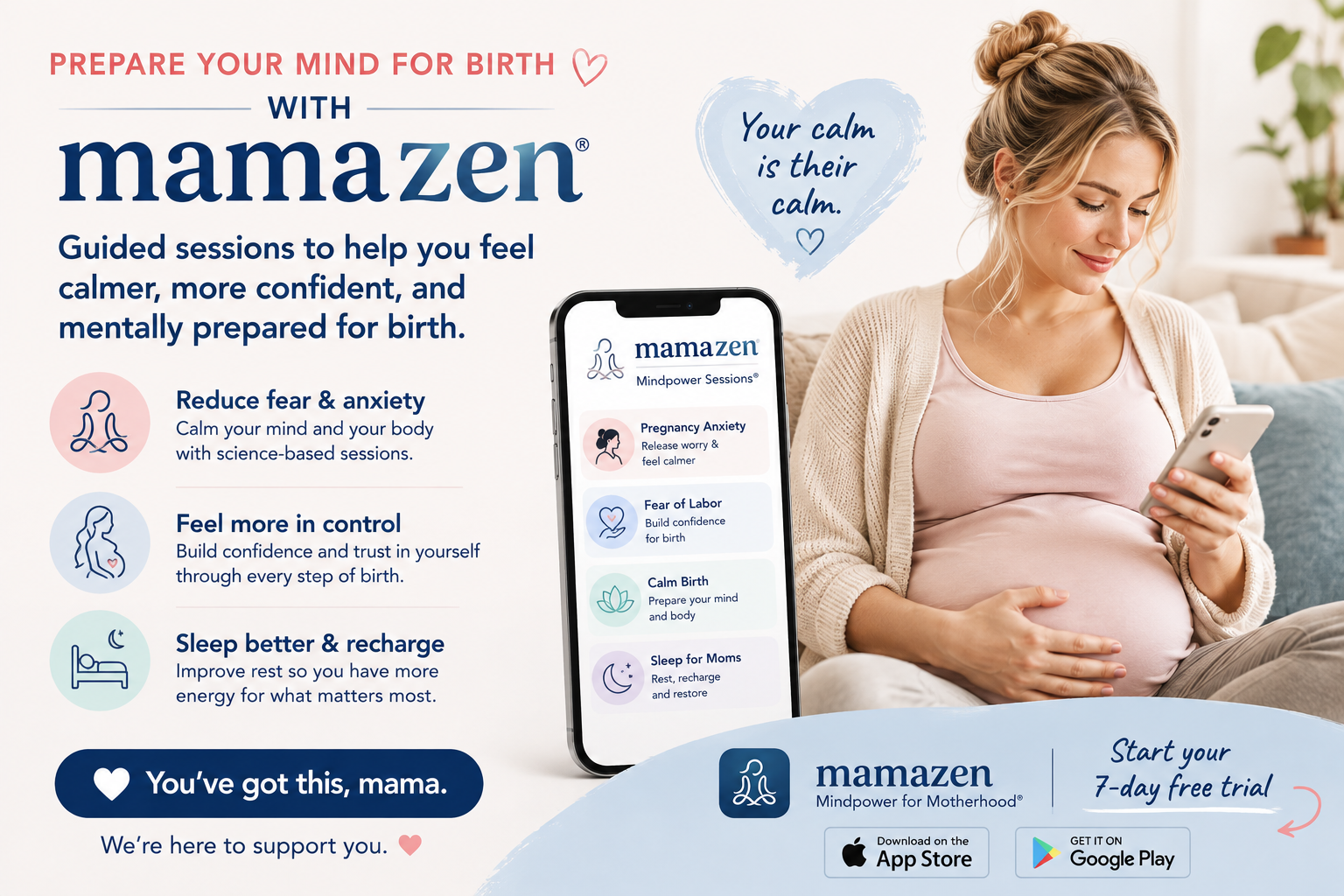
MamaZen includes guided Mindpower Sessions created specifically to support expecting mothers through pregnancy and birth preparation.
In just a few minutes, you can step away from the endless "what ifs," practice calming your mind, and begin building emotional tools you can take with you into labor.
You don't need to wait until you're panicking.
And you don't have to become completely fearless.
You can begin practicing now.
Start your MamaZen birth-preparation sessions and give your mind the same attention you've given every other part of preparing for your baby.
Being ready to give birth doesn't mean knowing exactly how your labor will unfold.
It doesn't mean never feeling nervous.
And it doesn't mean convincing yourself that nothing unexpected could happen.
Preparation can mean knowing who to call.
Knowing what matters to you.
Understanding your options.
Practicing ways to calm yourself when your thoughts begin racing.
Knowing who you want beside you.
And trusting that you can make decisions as each moment arrives.
You don't have to experience your entire birth in your imagination before it happens.
Today, you only have to prepare for today.
And when your baby's birth arrives, you can meet it one moment at a time.
Irin Rubin is the CEO and co-founder of MamaZen and the author of The MamaZen Method. Inspired by her own experience with pregnancy and postpartum anxiety, she has spent years developing mindfulness and cognitive hypnotherapy programs that support emotional well-being during pregnancy, birth, postpartum, and parenting.


Science-based Mindpower Sessions® help you create lasting change for you and your family.

Get instant relief right when you need it with our 5-7 Minute Emergency Sessions.

Empowering Kids to conquer anxiety, build confidence, and foster positive self-talk.

Supporting and guiding you through every step of parenthood.
Get expert tips to raise confident kids.
Enter email for access!