
Pregnancy is filled with incredible milestones.
Hearing your baby's heartbeat for the first time.
Feeling those first tiny kicks.
Watching your belly grow.
Imagining the day you'll finally meet your little one.
But alongside the excitement, many expecting moms experience something they weren't prepared for: anxiety.
You might find yourself lying awake wondering if your baby is okay.
You may worry before every ultrasound appointment, analyze every new sensation in your body, or catch yourself imagining worst-case scenarios that feel impossible to ignore.
If this sounds familiar, you're far from alone.
Anxiety is one of the most common emotional challenges during pregnancy. While every person's experience is different, many moms notice that their worries change as pregnancy progresses. The concerns that feel overwhelming during the first trimester are often very different from those that arise in the second or third trimester.
Understanding these changes can help you feel less alone and remind you that what you're experiencing is common.
In this guide, we'll explore how pregnancy anxiety often changes during each trimester, why your worries may shift over time, and practical ways to feel calmer throughout your pregnancy.
It's completely normal to worry about your baby from time to time.
Every parent wants a healthy pregnancy and a healthy baby. Questions like "Is everything okay?" or "Is this symptom normal?" are incredibly common.
Pregnancy anxiety goes beyond occasional worry. It may involve persistent anxious thoughts, difficulty relaxing, repeated reassurance seeking, or imagining frightening situations even when everything appears to be going well.
For some moms, anxiety shows up mostly as constant worrying.
For others, it can include:
Pregnancy anxiety exists on a spectrum. Some moms experience mild anxiety that comes and goes, while others find that anxious thoughts begin interfering with their daily lives.
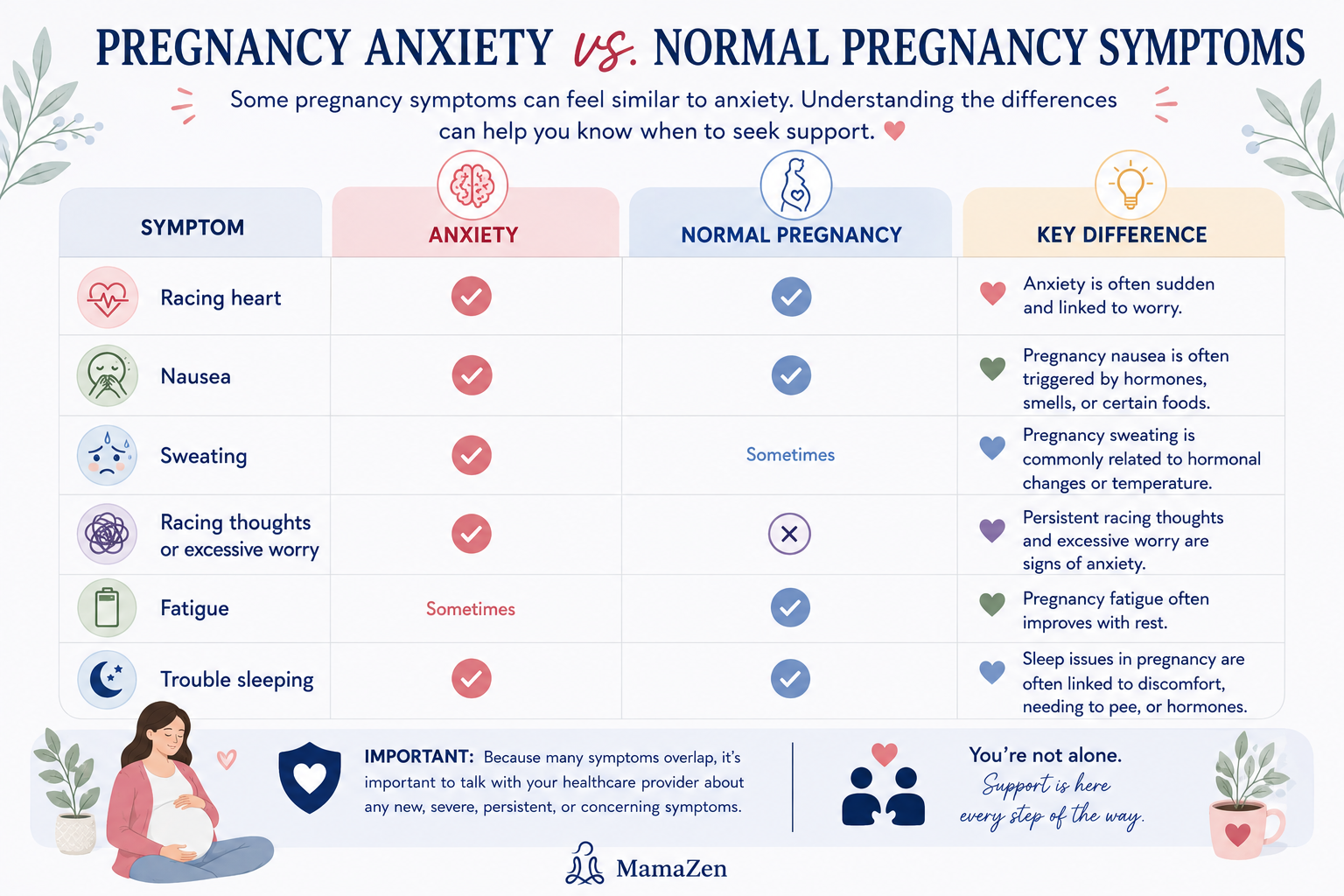
It's also important to remember that many physical sensations associated with anxiety—such as nausea, fatigue, dizziness, or a faster heartbeat—can also occur during a healthy pregnancy. If you notice new, severe, persistent, or concerning symptoms, or if you're unsure what's causing them, contact your healthcare provider for personalized guidance.
The reassuring news is that pregnancy anxiety is common, and experiencing anxious thoughts doesn't mean you're doing anything wrong or that you're already failing as a mother.
In many ways, your anxious mind is trying to do exactly what it believes is its job: protect your baby.
One of the most surprising things about pregnancy anxiety is that it rarely stays the same.
Many moms think,
"Once I hear the heartbeat, I'll finally relax."
Then they hear the heartbeat.
For a little while, they do feel better.
Until the next worry appears.
Maybe it's waiting for the genetic testing results.
Then it's the anatomy scan.
Then it's monitoring baby movements.
Then it's labor.
Then it's bringing the baby home.
The focus of anxiety often changes because every stage of pregnancy brings new questions and new unknowns.
Your brain naturally wants certainty.
Unfortunately, pregnancy involves months of waiting, uncertainty, and milestones that unfold one step at a time.
As soon as one concern is resolved, your brain may simply move on to the next possible threat.
This doesn't mean your anxiety is getting worse.
It often means your protective instincts are adapting to each new stage of pregnancy.
Many moms recognize a cycle that looks something like this:
Each milestone may bring temporary relief.
But anxiety isn't always looking for facts.
It's often looking for certainty.
And pregnancy rarely offers complete certainty.
Understanding this cycle can be incredibly freeing because it helps explain why reassurance sometimes only lasts a short time. Rather than trying to eliminate every possible uncertainty, many moms find it more helpful to learn skills that allow them to feel calmer even when not every question has an immediate answer.
For many women, the first trimester is the most emotionally challenging part of pregnancy.
Everything feels new.
Every symptom seems important.
And there are often very few visible signs that everything is progressing normally.
Unlike later in pregnancy, you can't yet feel your baby moving. You may still be waiting for your first ultrasound or your first opportunity to hear your baby's heartbeat.
This period of uncertainty naturally creates space for anxious thoughts.
Many expecting moms describe constantly wondering:
"Is my baby okay?"
"Is this cramping normal?"
"Should I still feel nauseous?"
"What if my symptoms disappear?"
"What if something goes wrong before my next appointment?"
These questions are incredibly common, especially for first-time moms or anyone who has experienced infertility, pregnancy loss, or previous pregnancy complications.
Several factors come together during the early weeks of pregnancy.
Hormones are changing rapidly, your body is adjusting to pregnancy, and many of the most important milestones are still ahead.
You're also carrying an enormous amount of uncertainty.
There are weeks between appointments.
Weeks before you can consistently hear or feel signs that your baby is growing.
Weeks where you simply have to trust that everything is progressing as expected.
For many moms, this waiting can feel emotionally exhausting.
Your mind naturally starts paying closer attention to every sensation.
A brief cramp.
A wave of nausea.
A moment when your breasts feel less sore.
A trip to the bathroom.
Each experience can become something your brain tries to interpret.
While it's understandable to notice changes in your body, anxiety often encourages constant monitoring and searching for certainty—something pregnancy simply can't always provide.
Recognizing this pattern is important because it allows you to respond with curiosity and self-compassion instead of assuming that every uncertain moment means something is wrong.
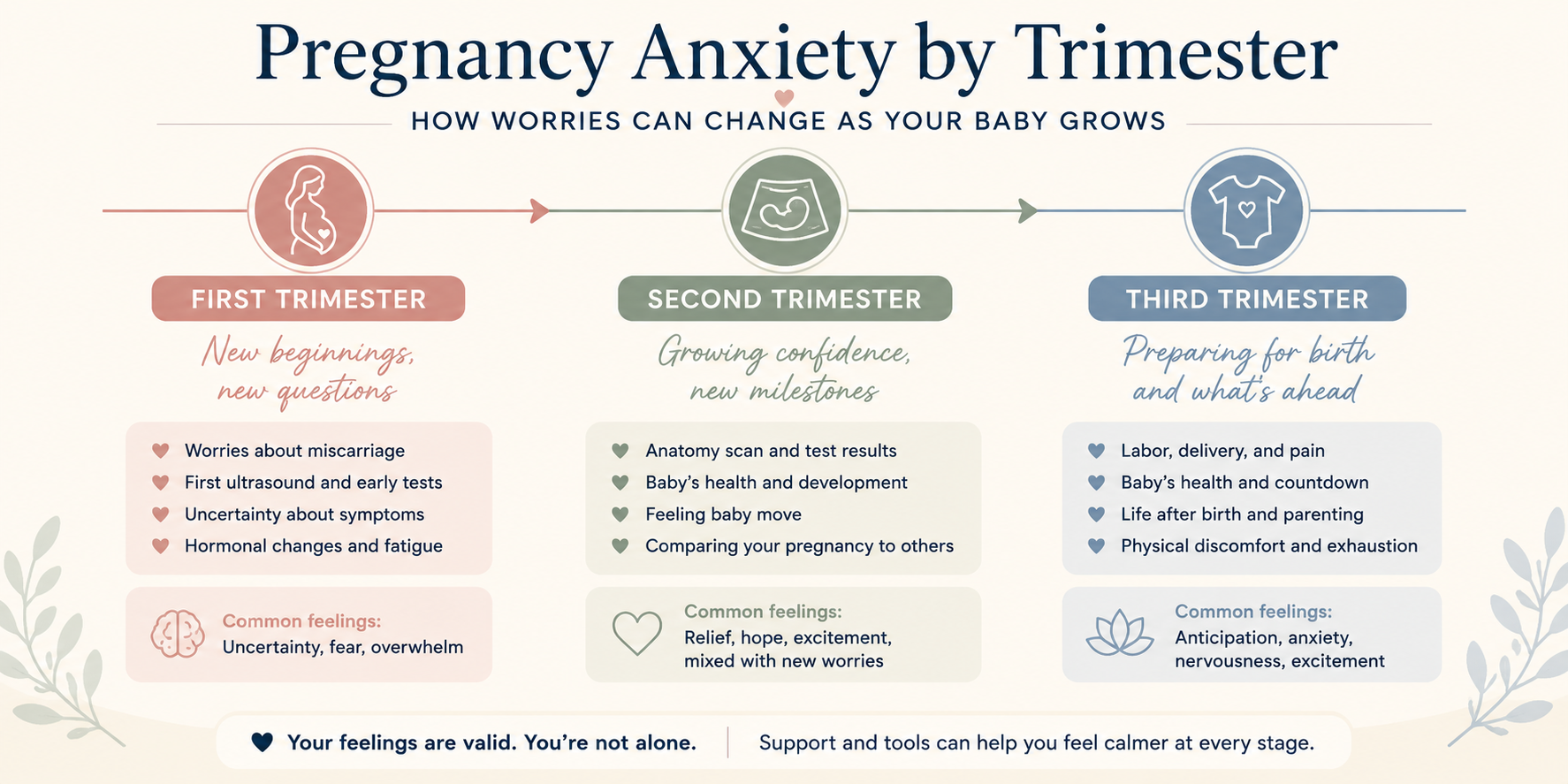
Although every pregnancy is unique, many moms share similar fears during the first trimester.
Some of the most common concerns include:
These worries can become especially intense because there are often days or even weeks between prenatal appointments.
Without frequent reassurance from a healthcare provider, your mind may fill those gaps with imagined possibilities.
That's one reason many moms notice themselves searching online repeatedly, checking pregnancy apps throughout the day, or comparing their symptoms with other people's experiences.
While looking for information can feel reassuring in the moment, it doesn't always reduce anxiety for long. Instead, it can sometimes reinforce the cycle of needing constant reassurance.
The good news is that there are healthier ways to build confidence and emotional resilience throughout pregnancy—skills that can support you not only during the first trimester, but throughout the months ahead.
Anxiety isn't just something you feel in your mind.
It can also show up throughout your body.
Many expecting moms are surprised to discover that anxiety can cause physical sensations that feel very real, including:
The challenge is that many of these symptoms can also occur during a healthy pregnancy, making it difficult to know what's causing them.
For example, nausea may be related to morning sickness, anxiety, or both. A faster heart rate is a normal part of pregnancy, but it can also become more noticeable when you're feeling anxious.
Because so many symptoms overlap, it's not always possible to tell the difference on your own. If you experience new, severe, persistent, or concerning symptoms—or you're unsure whether what you're experiencing is related to pregnancy or anxiety—contact your healthcare provider.
While you can't eliminate every uncertainty, you can reduce the amount of time anxiety spends in the driver's seat.
Many moms find these strategies helpful during the first trimester:
Anxiety likes to jump weeks or months into the future.
It asks questions like:
"What if something goes wrong?"
"What if my next appointment isn't okay?"
Instead of trying to answer every "what if," gently bring yourself back to today.
Ask yourself:
"Right now, in this moment, what do I actually know?"
This simple shift helps interrupt catastrophic thinking and reminds your brain to focus on facts rather than imagined possibilities.
It's tempting to search every symptom online or compare your pregnancy with someone else's.
Unfortunately, reassurance often provides only temporary relief.
You may feel calmer for a few minutes—or even a few hours—but before long, another question appears.
Over time, repeatedly searching for reassurance can unintentionally strengthen anxiety rather than reduce it.
If you notice yourself constantly checking pregnancy forums or Googling every new sensation, consider setting gentle limits around how often you search for answers online.
Many people wait until they feel overwhelmed before trying to calm themselves.
But calming techniques work best when they become part of your daily routine.
Even five or ten minutes of mindful breathing, guided relaxation, meditation, or gentle visualization each day can help support emotional well-being throughout pregnancy.
The goal isn't to eliminate every anxious thought.
It's to teach your nervous system that it can return to a calmer state when worry begins to build.
Many people describe the second trimester as the "honeymoon phase" of pregnancy.
Morning sickness often improves.
Energy may begin to return.
Your growing bump makes pregnancy feel more real.
You might even start feeling your baby's first movements.
For some moms, anxiety naturally eases during this stage.
For others, it simply changes.
Instead of worrying about whether the pregnancy is continuing, your thoughts may shift toward your baby's development and the major milestones still ahead.
This is often when new questions begin to appear.
"What if the anatomy scan finds something?"
"Is my baby moving enough?"
"Am I doing everything I should be doing?"
"What if I'm not preparing enough?"
Rather than disappearing, anxiety often evolves alongside your pregnancy.
Although many early pregnancy risks decrease as pregnancy progresses, uncertainty doesn't disappear.
The second trimester introduces several important milestones, including:
Each milestone can create its own emotional challenges.
Many moms find themselves counting the days until the anatomy scan, hoping for reassurance that everything is developing normally.
Others become increasingly aware of every movement, or lack of movement, and wonder whether what they're experiencing is normal.
As pregnancy becomes more visible, family members, friends, and even strangers often begin asking questions about the baby.
Although these conversations are usually well intentioned, they can sometimes make anxious thoughts feel even more present.
Around the middle of pregnancy, many parents look forward to the anatomy scan with a mixture of excitement and fear.
For weeks, you've probably been imagining this appointment.
You'll get to see your baby.
Maybe learn the sex.
Watch tiny hands and feet moving on the screen.
But alongside that excitement, many moms quietly carry another thought:
"What if they find something?"
Even parents whose pregnancies have been completely healthy often describe feeling nervous before this appointment.
Some find it difficult to sleep the night before.
Others feel anxious sitting in the waiting room or analyzing every facial expression from the ultrasound technician.
These reactions are common.
The anatomy scan is an important milestone, and it's natural to hope for reassuring news.
For many families, the appointment brings relief.
For others, waiting for follow-up information or additional testing can be emotionally challenging.
Whatever your experience, remember that feeling anxious before an important prenatal appointment doesn't mean something is wrong—it means you care deeply about your baby.
Although every pregnancy is different, many moms experience concerns such as:
These worries often reflect an increasing sense of responsibility.
As your connection with your baby grows, so does your desire to protect them.
That protective instinct is one of the reasons anxiety can sometimes become louder during pregnancy—it isn't a sign that you're doing anything wrong.
It's often your brain trying, in its own imperfect way, to keep your growing family safe.
The second trimester is often a wonderful time to begin building habits that can support you throughout the rest of your pregnancy and into early motherhood.
Rather than waiting until anxiety becomes overwhelming, consider using this period to strengthen your emotional resilience.
As your due date gets closer, your mind may naturally start thinking months into the future.
You might find yourself wondering:
"What if labor doesn't go as planned?"
"What if I can't handle the pain?"
"What if something changes before delivery?"
While planning ahead is helpful, spending too much time imagining worst-case scenarios rarely makes you feel more prepared.
Instead, gently remind yourself that today's job is simply today's pregnancy.
You don't have to solve labor, newborn sleep, or parenting challenges all at once.
Preparing for your baby can be empowering.
Creating a birth plan.
Setting up the nursery.
Taking childbirth classes.
Learning about breastfeeding.
Choosing a pediatrician.
These are all positive ways to feel ready.
At the same time, it's important to remember that preparation and control aren't the same thing.
Pregnancy, birth, and parenthood all involve uncertainty.
The goal isn't to control every outcome—it's to build confidence that you can adapt, whatever happens.
Anxiety naturally draws your attention toward possible problems.
Make space to notice the moments that anxiety often overlooks.
The first kick.
A reassuring prenatal appointment.
Seeing your baby on an ultrasound.
Hearing your partner talk to your growing belly.
Laughing while putting together the nursery.
These moments deserve your attention, too.
As the third trimester begins, pregnancy starts to feel very real.
Your due date is getting closer.
Hospital bags are being packed.
Baby clothes are folded.
Friends and family begin asking,
"Any signs yet?"
For many moms, anxiety increases again during these final weeks—not because they're doing anything wrong, but because they're approaching one of life's biggest transitions.
The questions often become much bigger.
"Will labor be as painful as everyone says?"
"What if I need an emergency C-section?"
"Will my baby be healthy?"
"How will I know when labor starts?"
"What if I can't do this?"
These worries are incredibly common.
Even women who have given birth before often experience new fears because every pregnancy and every birth is different.
Several factors come together during the final months of pregnancy.
The physical discomforts of pregnancy become more noticeable.
Sleep often becomes more difficult.
Medical appointments become more frequent.
Labor no longer feels like something far away—it feels close.
As your due date approaches, your brain naturally starts preparing for birth.
Sometimes that preparation feels exciting.
Sometimes it feels overwhelming.
Many moms also notice that friends, family members, and even strangers begin sharing birth stories.
While some are encouraging, others involve unexpected complications or frightening experiences.
Hearing these stories can make it easy for anxiety to imagine that the same thing will happen to you.
Remember that every birth is unique.
Someone else's experience is not a prediction of your own.
The final weeks of pregnancy often bring questions such as:
You may also find yourself thinking beyond birth for the first time.
Questions about sleep deprivation, postpartum recovery, feeding, or balancing your new identity as a parent can all become sources of anxiety.
These concerns don't mean you're unprepared.
They simply reflect that you're standing on the edge of a major life change.
Many moms notice that anxiety feels strongest after the sun goes down.
During the day, work, errands, appointments, and conversations provide distractions.
At night, everything becomes quiet.
Without those distractions, anxious thoughts often become much louder.
You may find yourself replaying conversations with your healthcare provider.
Counting the hours until your next appointment.
Wondering whether the baby has moved enough.
Imagining different labor scenarios.
Or lying awake even though your body is exhausted.
Poor sleep can also make anxious thoughts feel more intense the following day, creating a cycle that's difficult to break.
Developing a relaxing bedtime routine, limiting late-night internet searches, and practicing guided relaxation before bed may help your mind settle more easily.
By the third trimester, it can become even harder to distinguish between normal pregnancy sensations and physical symptoms of anxiety.
You might notice:
Many of these sensations can occur during a healthy pregnancy for reasons unrelated to anxiety.
If you experience symptoms that are new, severe, persistent, or concerning—or you notice changes that worry you—contact your healthcare provider promptly.
It's always appropriate to ask questions when you're unsure.
While it's normal to think more about labor as your due date approaches, you don't have to spend these final weeks feeling consumed by fear.
Many moms find it helpful to focus on building confidence rather than trying to predict every possible outcome.
Remind yourself that your healthcare team has prepared for many different birth scenarios.
You've been preparing throughout your pregnancy.
And you don't have to know exactly how every moment of labor will unfold in order to move through it one step at a time.
Practicing relaxation techniques, guided mindfulness, breathing exercises, and positive birth preparation can help you approach labor with greater calm and confidence—even if some uncertainty remains.
The goal isn't to eliminate every fear.
It's to remind yourself that you can experience uncertainty and still move forward with courage.
Although anxiety often changes as pregnancy progresses, some worries aren't tied to any particular stage.
Whether you're six weeks pregnant or just days away from meeting your baby, you may experience concerns that come and go throughout your pregnancy.
Recognizing these patterns can help you remember that you're not alone.
Many expecting moms experience unwanted thoughts that seem to appear out of nowhere.
You might suddenly imagine something bad happening to your baby.
Picture yourself making a mistake.
Or wonder, "Why would I even think that?"
These thoughts can feel frightening because they don't reflect what you want.
In fact, they usually reflect the exact opposite.
The more you love your baby, the more upsetting these thoughts can feel.
Having an intrusive thought does not mean you want it to happen or that it predicts the future.
Many people experience intrusive thoughts during pregnancy. If they become frequent, highly distressing, or interfere with your daily life, it's a good idea to discuss them with your healthcare provider or a mental health professional.
Some women experience panic attacks for the first time during pregnancy.
Others may notice that existing panic attacks become more frequent.
A panic attack can include symptoms such as:
Because these symptoms can feel intense, it's important to contact your healthcare provider if you're experiencing them for the first time or if you're unsure what's causing them.
Pregnancy naturally brings increased attention to your body.
You notice movements.
Symptoms.
Appointments.
Test results.
This awareness is normal.
Sometimes, however, it can become difficult to stop monitoring every sensation.
You may find yourself repeatedly asking:
"Was that movement normal?"
"Should I be feeling this?"
"What if I missed something?"
Health anxiety can make it difficult to feel reassured, even after receiving positive news from your healthcare provider.
Not all pregnancy anxiety is about your baby's health.
Many parents also worry about:
These concerns are a normal part of preparing for a growing family.
If these worries begin to feel overwhelming, talking openly with your partner, a trusted friend, or a counselor can help you feel more supported.
If you've experienced a miscarriage, infertility, stillbirth, pregnancy complications, or a difficult birth in the past, pregnancy can bring a unique set of emotions.
Many parents describe feeling grateful and excited while also carrying significant fear.
You may notice yourself waiting for something to go wrong because you've experienced uncertainty before.
These feelings are understandable.
Your previous experiences may influence how you feel during this pregnancy, but they do not determine what will happen this time.
Giving yourself permission to acknowledge both hope and fear can be an important part of healing.
Every pregnant woman worries sometimes.
It's part of caring deeply about your growing baby.
However, there are times when anxiety deserves additional attention and support.
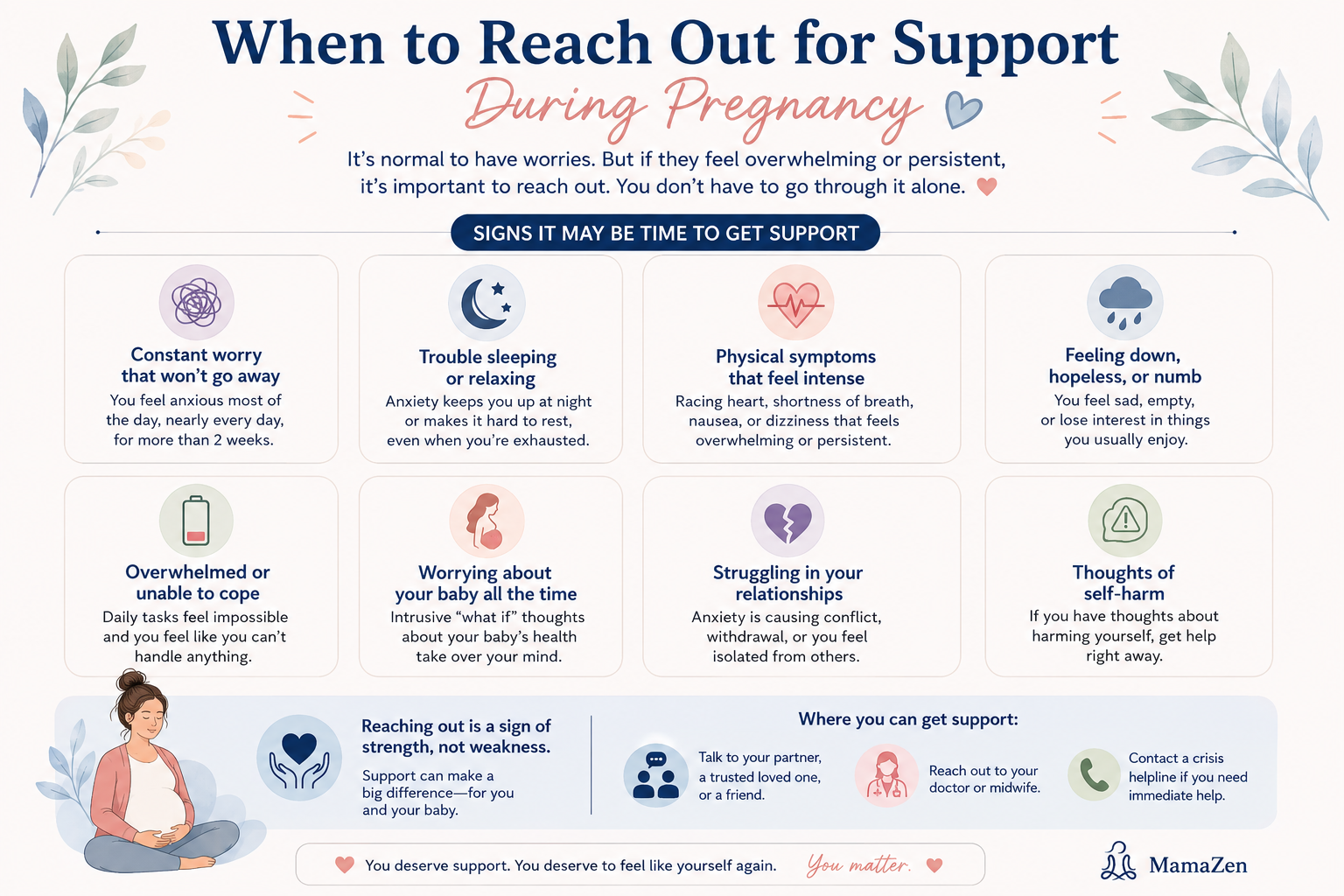
Consider speaking with your healthcare provider if you notice that anxiety is:
You don't have to wait until anxiety feels unbearable to ask for help.
Support is available, and many effective approaches can help you feel calmer throughout pregnancy.
If you ever experience thoughts of harming yourself or feel that you're in immediate danger, seek emergency medical care or contact emergency services right away.
Although every stage of pregnancy brings different challenges, the same healthy habits can support your emotional well-being from the first trimester through birth.
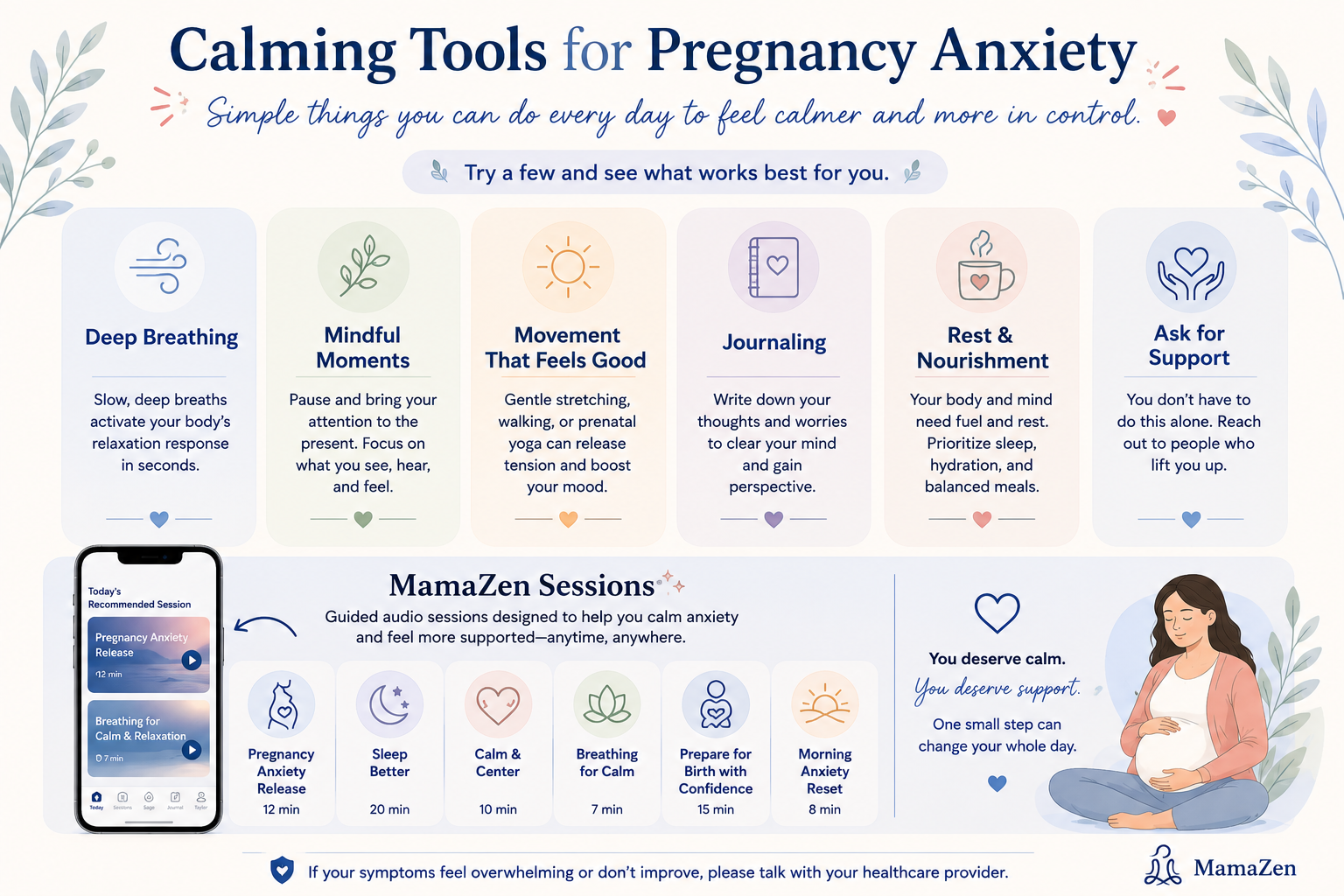
Your nervous system responds best to consistency.
Rather than waiting until anxiety becomes overwhelming, try incorporating small moments of calm into each day.
Even five or ten minutes of guided relaxation, mindful breathing, or meditation can help create a stronger foundation for handling stressful moments.
It's natural to search for answers online.
But endless scrolling through forums, social media, and worst-case stories often leaves moms feeling more anxious rather than more informed.
Choose trusted sources of information, and give yourself permission to step away from the internet when you notice your anxiety increasing.
If your healthcare provider says it's appropriate for your pregnancy, gentle movement can be a wonderful way to support both your physical and emotional well-being.
Walking.
Prenatal yoga.
Stretching.
Swimming.
Even a few minutes of movement can help many moms feel more grounded.
Sleep isn't always easy during pregnancy.
But creating a calming bedtime routine can make a difference.
Consider dimming the lights before bed, putting away your phone, listening to a guided relaxation session, or practicing slow breathing as you settle in for the night.
Remember that rest matters even if sleep doesn't come immediately.
Pregnancy can sometimes feel isolating, especially if anxiety convinces you that you're the only one struggling.
Talking with your partner, a trusted friend, another mom, or your healthcare provider can remind you that your feelings are valid and that support is available.
Many moms become incredibly hard on themselves during pregnancy.
They worry they're worrying too much.
They feel guilty for feeling anxious.
They wonder whether their emotions somehow make them a bad mother.
The truth is just the opposite.
The fact that you're worried often reflects how deeply you already love your baby.
Instead of criticizing yourself for feeling anxious, try speaking to yourself with the same kindness you would offer a close friend.
There isn't one answer that applies to everyone.
Many moms experience heightened anxiety during the first trimester because of uncertainty and concerns about early pregnancy. Others notice anxiety increasing again during the third trimester as labor and birth approach.
Some people experience anxiety throughout pregnancy, while others have only brief periods of worry.
Yes. Many expecting mothers experience periods of worry during pregnancy.
However, if anxiety becomes persistent, overwhelming, or begins interfering with your daily life, it's important to discuss it with your healthcare provider.
For some moms, yes.
As morning sickness improves and pregnancy begins to feel more established, anxiety may ease.
For others, new concerns—such as the anatomy scan, fetal movement, or preparing for birth—replace earlier worries.
Absolutely.
You may feel calm for several days or weeks and then notice anxiety increasing before an appointment, after reading something online, or as a new pregnancy milestone approaches.
Fluctuations are common.
Pregnancy anxiety doesn't always stay the same.
As your baby grows, your worries often evolve too.
You may spend the first trimester worrying about miscarriage, the second trimester thinking about your baby's development, and the third trimester wondering about labor and life after birth.
Understanding these changing patterns can help you recognize that you're not alone and that your experience is shared by many other expecting moms.
While pregnancy will always include some uncertainty, it doesn't have to be consumed by fear.
Learning healthy ways to calm your mind, care for your nervous system, and seek support when you need it can help you move through each trimester with greater confidence.
And remember, you don't have to navigate pregnancy anxiety by yourself. Whether that support comes from your healthcare provider, loved ones, or mindfulness tools like MamaZen's pregnancy sessions, reaching out for support is a sign of strength—not weakness.


Science-based Mindpower Sessions® help you create lasting change for you and your family.

Get instant relief right when you need it with our 5-7 Minute Emergency Sessions.

Empowering Kids to conquer anxiety, build confidence, and foster positive self-talk.

Supporting and guiding you through every step of parenthood.
Get expert tips to raise confident kids.
Enter email for access!