
You counted down the days until your anatomy scan.
Maybe you told yourself:
"Once I know everything looks okay, I'll finally be able to relax."
For weeks, the appointment felt like the milestone that would quiet your worries.
Then the day arrived.
You watched your baby move across the screen.
You heard the heartbeat.
The sonographer measured tiny fingers, toes, and organs.
Your healthcare provider told you that everything appeared normal.
You walked out feeling lighter.
Finally, you could breathe again.
But then, a few days later...
The anxiety started creeping back.
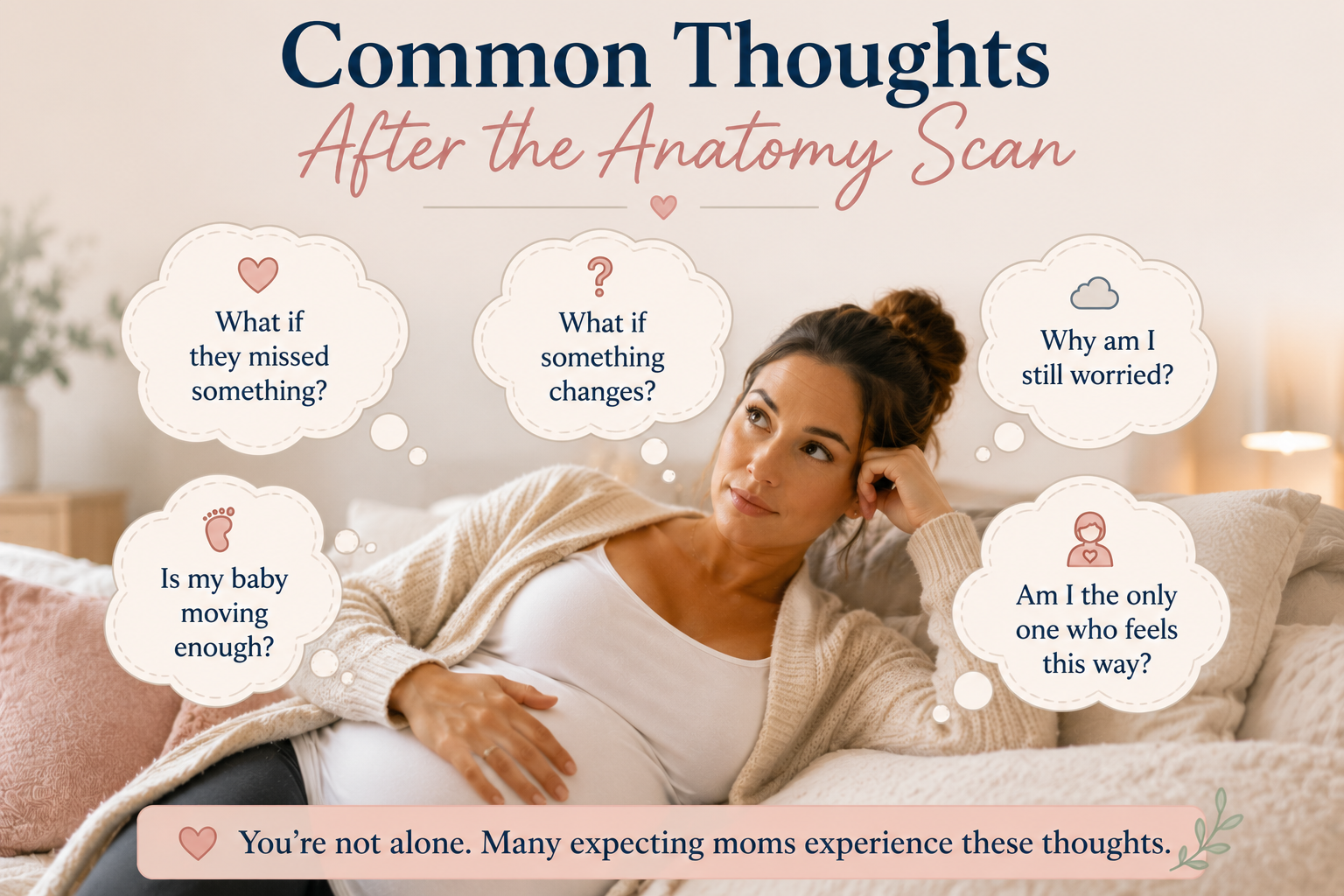
"What if they missed something?"
"What if something changes before my next appointment?"
"Why am I still worried when I should feel relieved?"
If this sounds familiar, you're far from alone.
Many expecting mothers feel disappointed, or even guilty, when anxiety returns after a reassuring anatomy scan. They wonder why they can't simply enjoy their pregnancy now that they've received good news.
The truth is that pregnancy anxiety doesn't always disappear after a normal scan. For many people, the anatomy scan provides reassurance for a little while, but the underlying anxiety soon finds something new to worry about.
That doesn't mean anything is wrong with your pregnancy.
It doesn't mean you're ungrateful.
And it certainly doesn't mean you're already a bad mother.
It simply means your mind is trying very hard to protect someone you already love.
The anatomy scan is one of the biggest milestones during pregnancy.
It's usually performed between 18 and 22 weeks and gives your healthcare provider a detailed look at your baby's development.
During the scan, they may examine your baby's:
Many parents also choose to learn their baby's sex during this appointment.
For many families, it's one of the most exciting moments of pregnancy. Seeing your baby move, yawn, stretch, or suck their thumb can make everything feel wonderfully real.
A normal anatomy scan is very reassuring and provides valuable information about your baby's development. However, no prenatal test can identify every possible condition before birth. If you have questions about your scan results or concerns about your pregnancy, your healthcare provider is the best person to guide you.
Many moms imagine their anxiety has a finish line.
They tell themselves:
"I'll stop worrying after the anatomy scan."
Then the scan comes back normal.
Relief washes over them.
For a few hours, or maybe even a few days, they finally feel peaceful.
But then another thought appears.
"What if something changes?"
"What if my baby stops growing?"
"What if they overlooked something?"
"What if I don't notice a problem?"
The anxiety doesn't disappear.
It simply changes topics.
This is one of the most frustrating parts of pregnancy anxiety.
You finally receive the reassurance you've been waiting for, yet your mind quickly begins searching for the next uncertainty.
One reason this happens is that anxiety isn't always satisfied with reassurance.
Instead, it often craves certainty.
The challenge is that pregnancy is full of uncertainty.
Even after a healthy anatomy scan, there are still months of pregnancy ahead.
There are more appointments.
More ultrasounds for some pregnancies.
Changes in your baby's movement.
Labor.
Delivery.
Parenthood.
Your mind naturally starts asking questions about each new stage.
When your brain is feeling anxious, it often treats uncertainty as if it's a problem that must be solved immediately.
It starts scanning for anything that could possibly go wrong.
Not because it knows something is wrong...
But because it's trying to make sure nothing is.
Ironically, the more your brain searches for complete certainty, the more anxious it can become, because pregnancy simply doesn't offer absolute guarantees.
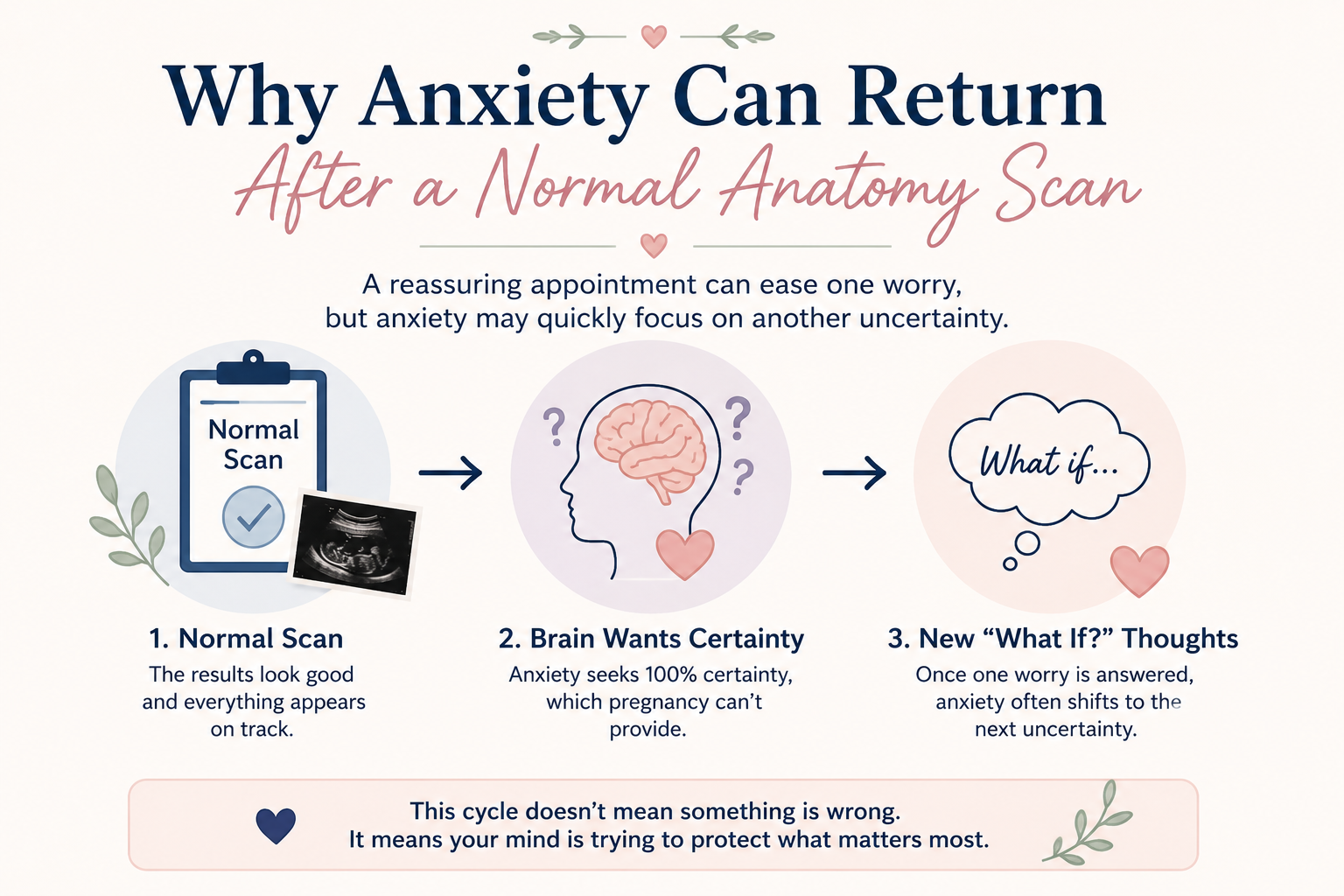
Many moms notice they get caught in a pattern that looks something like this:
You worry.
↓
You wait for your appointment.
↓
Everything looks healthy.
↓
You feel relieved.
↓
A few days pass.
↓
A new worry appears.
↓
You start counting down until your next appointment.
This cycle can repeat throughout pregnancy.
One week it's the anatomy scan.
The next week it's fetal movement.
Later it becomes labor.
Then delivery.
Then bringing your baby home.
The specific worry changes, but the anxious pattern often stays the same.
This doesn't happen because the previous reassurance was false.
It happens because reassurance usually answers one question, while anxiety quickly creates another.
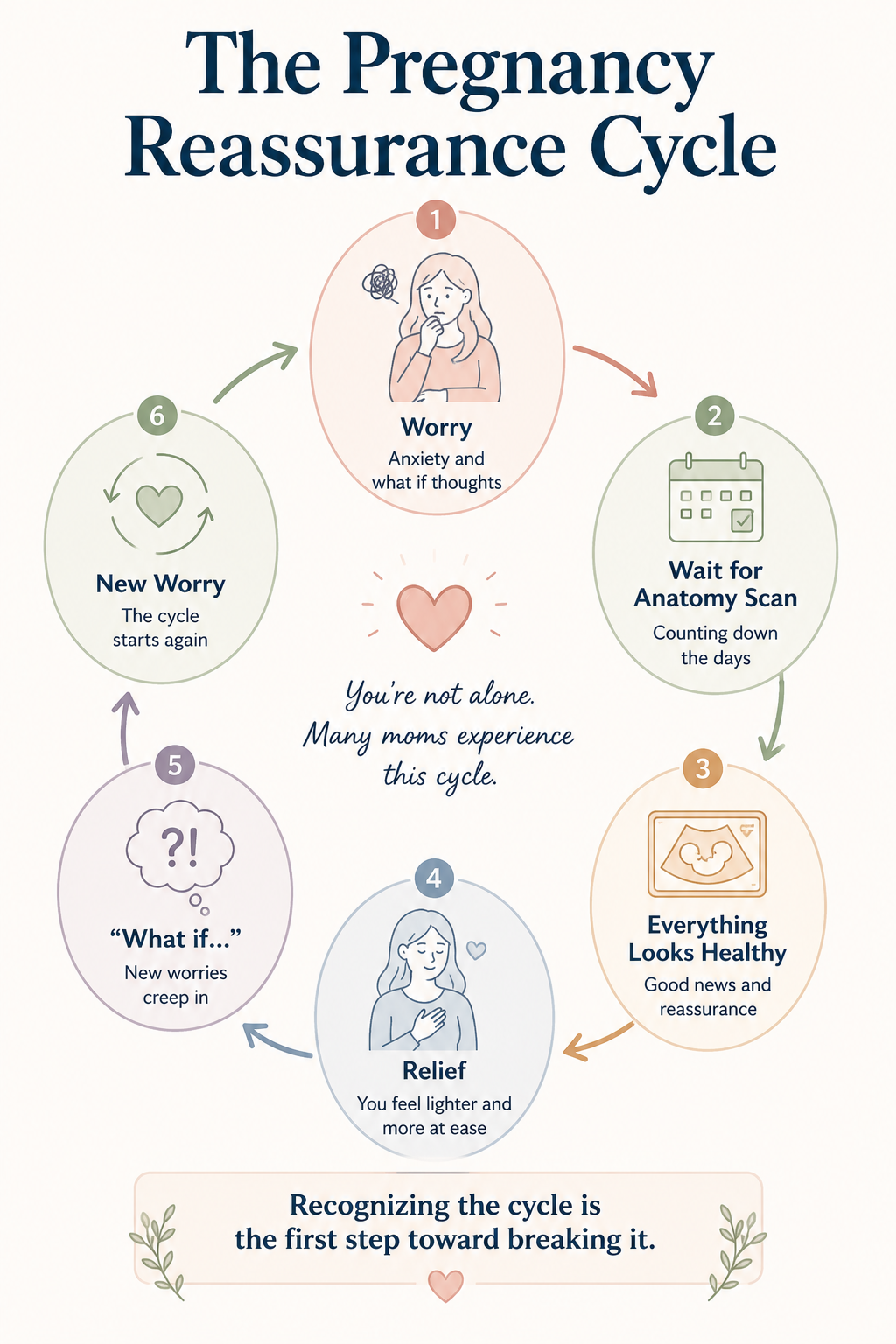
Many moms notice that each milestone brings temporary relief, followed by a new wave of worry and racing thoughts.
For example:
Each milestone may feel like the point where you'll finally be able to relax. But if anxiety is driving the worry, your mind often moves on to the next unknown instead.
Recognizing this pattern can be reassuring in itself. It reminds you that the anxiety isn't necessarily responding to new problems, it's responding to uncertainty.
If your anatomy scan was reassuring but your anxiety has returned, your thoughts might sound familiar.
Many expecting mothers find themselves wondering:
Although these worries can feel incredibly convincing, they're also very common.
Pregnancy is one of the few times in life where you deeply love someone you've never met, while having very little control over what happens from one day to the next.
That combination naturally creates vulnerability.
Emotional changes during pregnancy aren't only psychological. Hormonal shifts can also influence mood and emotional processing, making some women feel more sensitive to stress or uncertainty. While hormones don't cause every anxious thought, they may contribute to why emotions can feel more intense during pregnancy.
Many expecting mothers are surprised by how vivid their imagination becomes during pregnancy.
A small ache turns into a frightening possibility.
A quiet morning becomes a reason to question whether everything is okay.
An internet search leads to stories that are rare but suddenly feel personal.
This doesn't necessarily mean you're becoming irrational.
Your brain is adapting to one of the biggest changes you'll ever experience.
As pregnancy progresses, many people become more aware of potential risks because protecting your baby becomes one of your brain's highest priorities.
Your mind starts paying closer attention to unfamiliar sensations.
It notices every new symptom.
It compares today's experience with yesterday's.
It remembers alarming stories more easily than reassuring ones.
From an evolutionary perspective, paying attention to possible dangers may have helped parents stay alert to genuine threats. Today, however, that same protective instinct can sometimes become overactive, causing your mind to focus on possibilities that are unlikely rather than on the reassuring information you already have.
That's why even after a healthy anatomy scan, your thoughts may continue asking, "But what if?"
Those thoughts can feel loud, but they are not evidence that something is wrong. They are simply thoughts, and for many moms, they are a common part of navigating pregnancy with an anxious mind.
It's completely normal to have worries during pregnancy.
Most expecting parents wonder whether their baby is growing well, whether labor will go smoothly, or whether they'll be a good parent.
But sometimes those worries become so frequent or intense that they begin affecting daily life.
Pregnancy anxiety can look different for everyone, but some common signs include:
Many moms also notice that anxiety becomes cyclical.
One concern fades, only to be replaced by another.
For example, you may spend weeks worrying about the anatomy scan.
Once that appointment goes well, your attention shifts to fetal movement.
Then labor.
Then delivery.
Then bringing your baby home.
Instead of disappearing, anxiety simply finds a new place to focus.
If your anxiety feels persistent, overwhelming, or is making it difficult to enjoy everyday life, it's important to talk with your healthcare provider. Support is available during pregnancy, and you don't have to manage these feelings alone.
While occasional worry is a normal part of pregnancy, anxiety can sometimes become more persistent.
If you find that anxious thoughts are interfering with your sleep, relationships, work, or ability to enjoy daily life, talk with your healthcare provider. They can help determine whether additional support, such as counseling or other treatment options, may be appropriate for you.
Seeking help is not a sign of weakness. Many women experience anxiety during pregnancy, and support is available.
While you can't eliminate every uncertainty that comes with pregnancy, you can learn ways to respond differently to anxious thoughts.
The goal isn't to stop caring.
It's to stop letting worry take over every moment.
Here are several strategies that many moms find helpful.
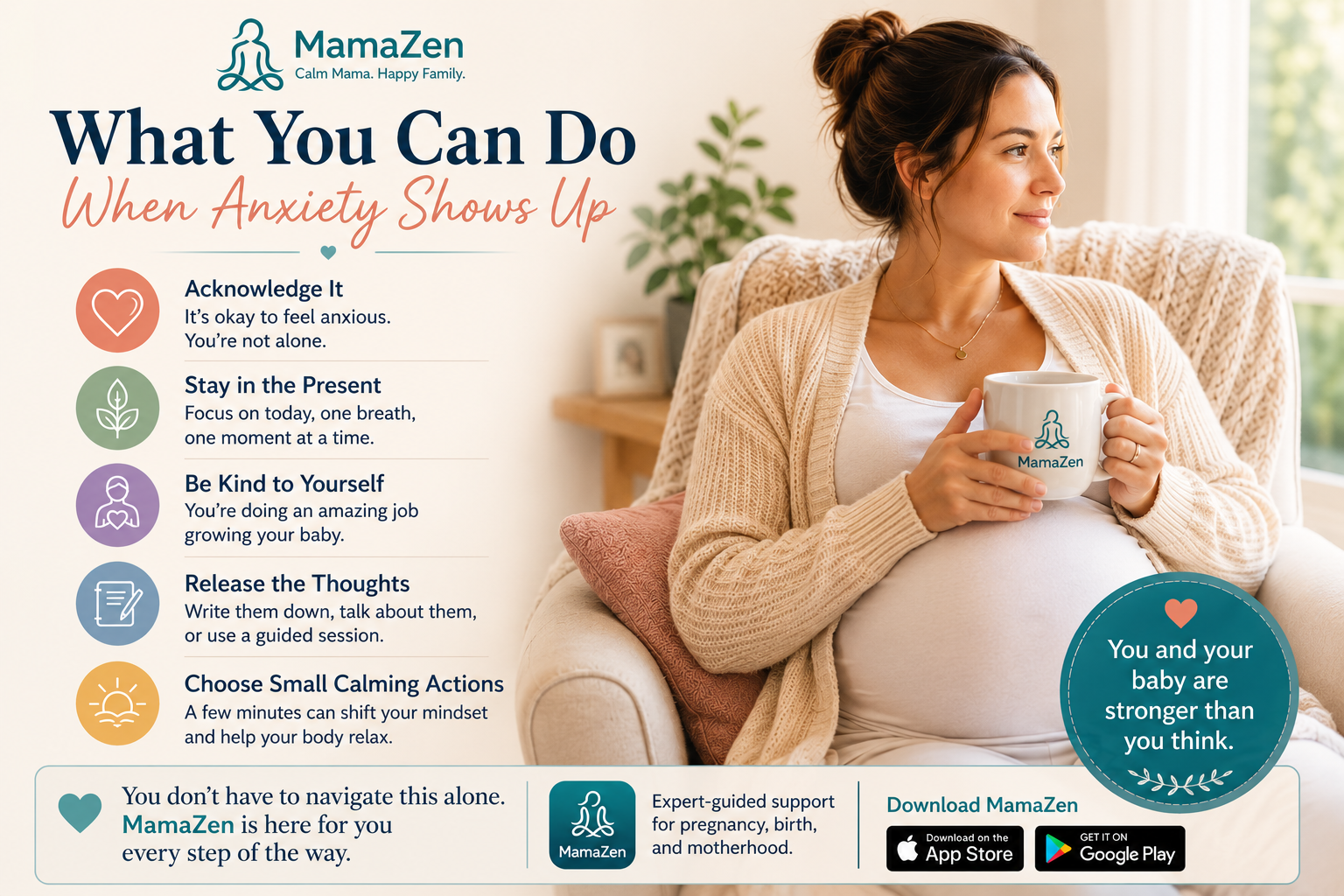
One of anxiety's favorite tricks is convincing you that thinking about something makes it more likely to happen.
You might think:
"What if something is wrong?"
Your anxious brain treats that question like evidence.
But it's only a thought.
Our minds generate thousands of thoughts every day.
Some are helpful.
Some are random.
Some are based on fear rather than facts.
Having a frightening thought does not make it true.
When you notice yourself spiraling, gently remind yourself:
"This is a worried thought, not a prediction."
That simple shift can help create a little distance between you and the anxiety.
Anxiety constantly pulls you into the future.
It asks questions that no one can answer.
"What if something changes next week?"
"What if labor is difficult?"
"What if..."
Instead of trying to answer every "what if," bring yourself back to what you know today.
Today, what information do you have?
Perhaps your anatomy scan was reassuring.
Perhaps your healthcare provider is happy with your baby's growth.
Perhaps you're feeling your baby move.
Those are facts.
The anxious thoughts are possibilities.
Grounding yourself in today's facts can be much more calming than trying to solve tomorrow's uncertainties.
When anxiety feels overwhelming, it's natural to look for reassurance.
You may find yourself:
While reassurance often brings temporary relief, it doesn't usually last.
Before long, another question appears.
Or you wonder whether the reassurance was complete enough.
This can create a cycle where you feel increasingly dependent on checking, searching, or asking for reassurance just to feel calm.
Instead, notice when you're seeking reassurance out of fear rather than because something has actually changed.
If you have new or concerning symptoms, contacting your healthcare provider is always appropriate. But if you find yourself repeatedly searching for certainty online, it may help to pause and ask whether the search is easing your anxiety, or feeding it.
Pregnancy gives you access to an endless stream of information.
Apps.
Videos.
Social media.
Forums.
Articles.
While education can be empowering, constantly consuming pregnancy content can sometimes increase anxiety instead of reducing it.
This is especially true when you're reading personal stories from strangers online.
People are naturally more likely to share unusual or difficult experiences than routine, healthy pregnancies.
As a result, your brain can begin to believe that rare outcomes are much more common than they actually are.
Consider choosing a few trusted sources for pregnancy information and giving yourself permission to step away when scrolling starts making you feel more anxious than informed.
When anxiety becomes the loudest voice in your mind, it can steal some of the excitement from this season.
You may feel like you're simply trying to make it from one appointment to the next.
Instead, look for small moments that help you connect with your pregnancy.
You might:
These moments don't erase anxiety.
But they can remind you that pregnancy is about more than waiting for the next reassurance.
An anxious mind is often connected to a tense body.
When your nervous system feels activated, it becomes easier for worried thoughts to take over.
Creating even a few minutes of calm each day may help you feel more grounded.
Many expecting moms enjoy practices such as:
The goal isn't to make anxiety disappear overnight.
It's to teach your body that moments of calm are still possible, even when uncertainty exists.
Over time, these small practices can become part of a healthier response to stress throughout pregnancy.
You don't have to wait until your baby is born to start feeling calmer. While pregnancy will always include unknowns, many moms find that learning how to respond differently to anxious thoughts helps them enjoy more of this unique season instead of spending it counting down to the next appointment.
Many moms believe they'll finally relax after the next ultrasound.
Or the next prenatal visit.
Or after viability.
Or after birth.
But if anxiety is always waiting for the next milestone before allowing you to feel calm, that finish line keeps moving.
Pregnancy will always include some uncertainty.
The good news is that calm doesn't have to depend on having all the answers.
You can learn to respond differently to anxious thoughts, even while some questions remain unanswered.
That doesn't mean pretending you're never worried.
It means recognizing that worry doesn't have to control your entire pregnancy.
You deserve moments of excitement.
Moments of peace.
Moments where you simply enjoy feeling your baby grow.
If you're finding it difficult to quiet racing thoughts after your anatomy scan, know that you're not alone. Many moms discover that mindfulness, guided relaxation, and other emotional wellness tools help them navigate pregnancy with greater confidence and less overwhelm.
MamaZen was created to support women through pregnancy, birth, postpartum, and motherhood with short, guided mindfulness and hypnotherapy sessions designed to help calm racing thoughts, reduce stress, improve sleep, and make it easier to enjoy the journey, one day at a time.
Yes. Many expecting mothers feel relieved immediately after receiving reassuring anatomy scan results, only to notice their worries returning days later. Pregnancy anxiety often isn't about the scan itself—it's about the uncertainty that naturally comes with pregnancy. If your mind quickly finds something new to worry about, you're not alone.
A reassuring anatomy scan answers many important questions, but it can't remove every uncertainty about pregnancy. For some moms, anxiety seeks complete certainty rather than reassurance. Once one concern is resolved, the mind may shift its focus to another, such as fetal movement, labor, or the next prenatal appointment.
It can. Some women notice that their anxiety changes rather than disappears after the anatomy scan. Instead of worrying about the scan results, they may begin worrying about their baby's movements, growth, labor, or whether something could change before delivery.
Yes. A normal ultrasound is reassuring, but it's common for pregnancy anxiety to return if your mind continues searching for certainty. Many expecting mothers experience periods of relief followed by new worries, even after receiving positive news from their healthcare provider.
Many expecting mothers experience recurring "what if" thoughts during pregnancy. These thoughts are often driven by anxiety and a strong desire to protect your baby, not by evidence that something is actually wrong. If your worries become persistent, overwhelming, or interfere with your daily life, talk with your healthcare provider. They can help you find the right support.
Yes. Some moms notice a repeating cycle where they feel anxious before an appointment, relieved afterward, and then gradually begin worrying again as the next visit gets closer. Recognizing this pattern can help you understand that anxiety is often responding to uncertainty rather than new problems.
No. Worrying does not predict pregnancy outcomes. Having anxious thoughts doesn't mean something bad will happen or that you're "jinxing" your pregnancy. Thoughts are not facts, and many healthy pregnancies include periods of worry.
It's a good idea to speak with your healthcare provider if anxiety feels persistent, overwhelming, or begins affecting your sleep, work, relationships, or ability to enjoy everyday life. They can help determine whether additional support or treatment may be appropriate. You should also contact your provider if you have new, severe, persistent, or concerning symptoms or questions about your pregnancy.
For some women, anxiety improves after delivery, while for others it may continue into the postpartum period. If anxious thoughts persist after birth or begin interfering with your well-being, support is available. Reaching out early can help you feel more confident and supported as you adjust to life with your baby.
Irin Rubin is the CEO and co-founder of MamaZen and the author of The MamaZen Method. Inspired by her own experience with pregnancy and postpartum anxiety, she has spent years developing mindfulness and cognitive hypnotherapy programs that support emotional well-being during pregnancy, birth, postpartum, and parenting.


Science-based Mindpower Sessions® help you create lasting change for you and your family.

Get instant relief right when you need it with our 5-7 Minute Emergency Sessions.

Empowering Kids to conquer anxiety, build confidence, and foster positive self-talk.

Supporting and guiding you through every step of parenthood.
Get expert tips to raise confident kids.
Enter email for access!